JP 3-60, page 57
Joint Targeting
Joint Publication: Joint Targeting
31 January 2013 public edition
Searchable page text (OCR / PDF)
The Joint Targeting Cycle
II-27
b. Target location and plot of movement (if applicable).
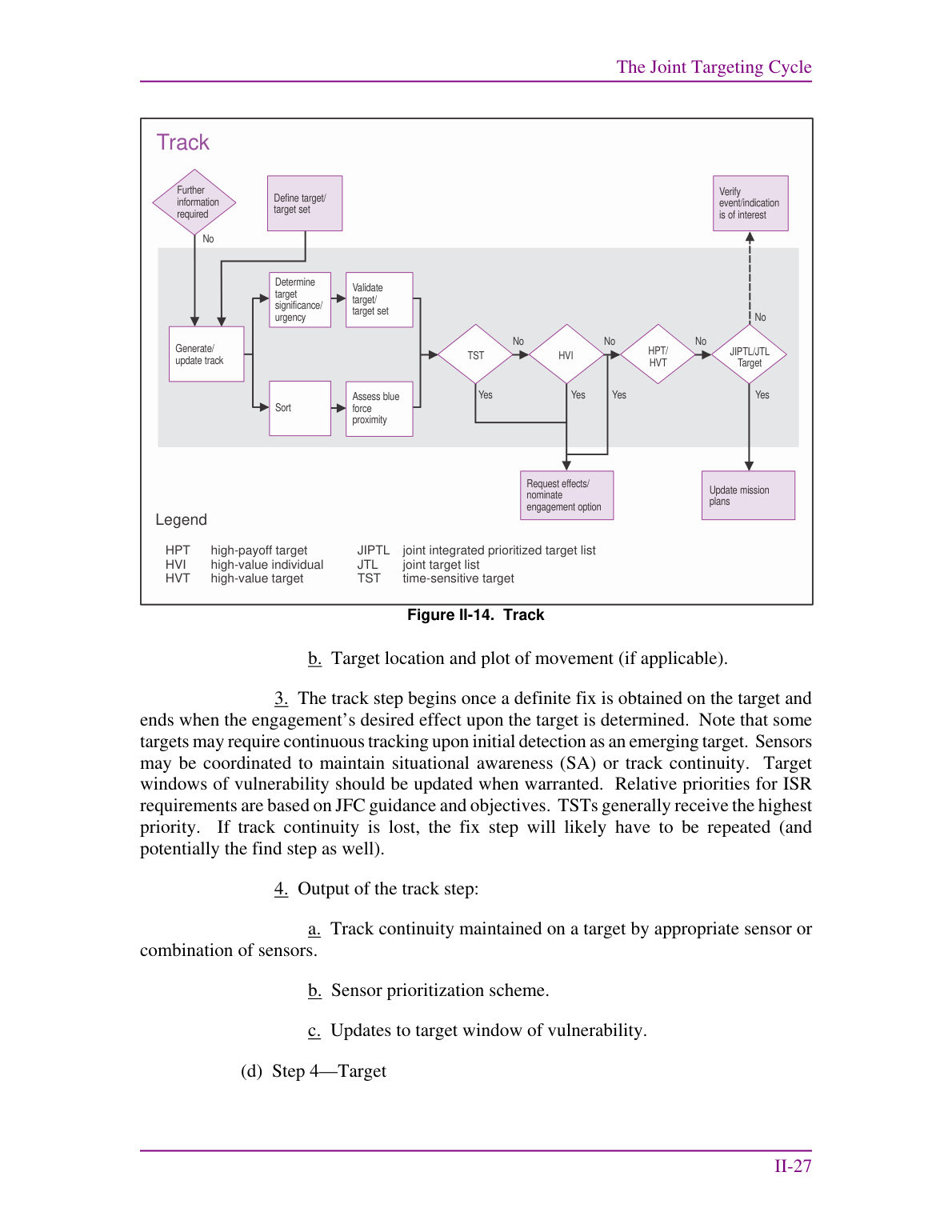
3. The track step begins once a definite fix is obtained on the target and
ends when the engagement’s desired effect upon the target is determined. Note that some
targets may require continuous tracking upon initial detection as an emerging target. Sensors
may be coordinated to maintain situational awareness (SA) or track continuity. Target
windows of vulnerability should be updated when warranted. Relative priorities for ISR
requirements are based on JFC guidance and objectives. TSTs generally receive the highest
priority. If track continuity is lost, the fix step will likely have to be repeated (and
potentially the find step as well).
4. Output of the track step:
a. Track continuity maintained on a target by appropriate sensor or
combination of sensors.
b. Sensor prioritization scheme.
c. Updates to target window of vulnerability.
(d) Step 4—Target
Figure II-14. Track
Track
HPT
high-payoff target
HVI
high-value individual
HVT
high-value target
JIPTL
joint integrated prioritized target list
JTL
joint target list
TST
time-sensitive target
Legend
Define target/
target set
Verify
event/indication
is of interest
Determine
target
significance/
urgency
Sort
No
No
No
No
No
Yes
Yes
Yes
Yes
TST
HVI
HPT/
HVT
JIPTL/JTL
Target
Further
information
required
Assess blue
force
proximity
Validate
target/
target set
Generate/
update track
Request effects/
nominate
engagement option
Update mission
plans