ATP 2-33.4, page 125
Intelligence Analysis
Army Techniques Publication: Intelligence Analysis
2014 public edition (Archive.org)
Searchable page text (OCR / PDF)
18 August 2014
ATP 2-33.4
B-1
Appendix B
Indicators in Decisive Action
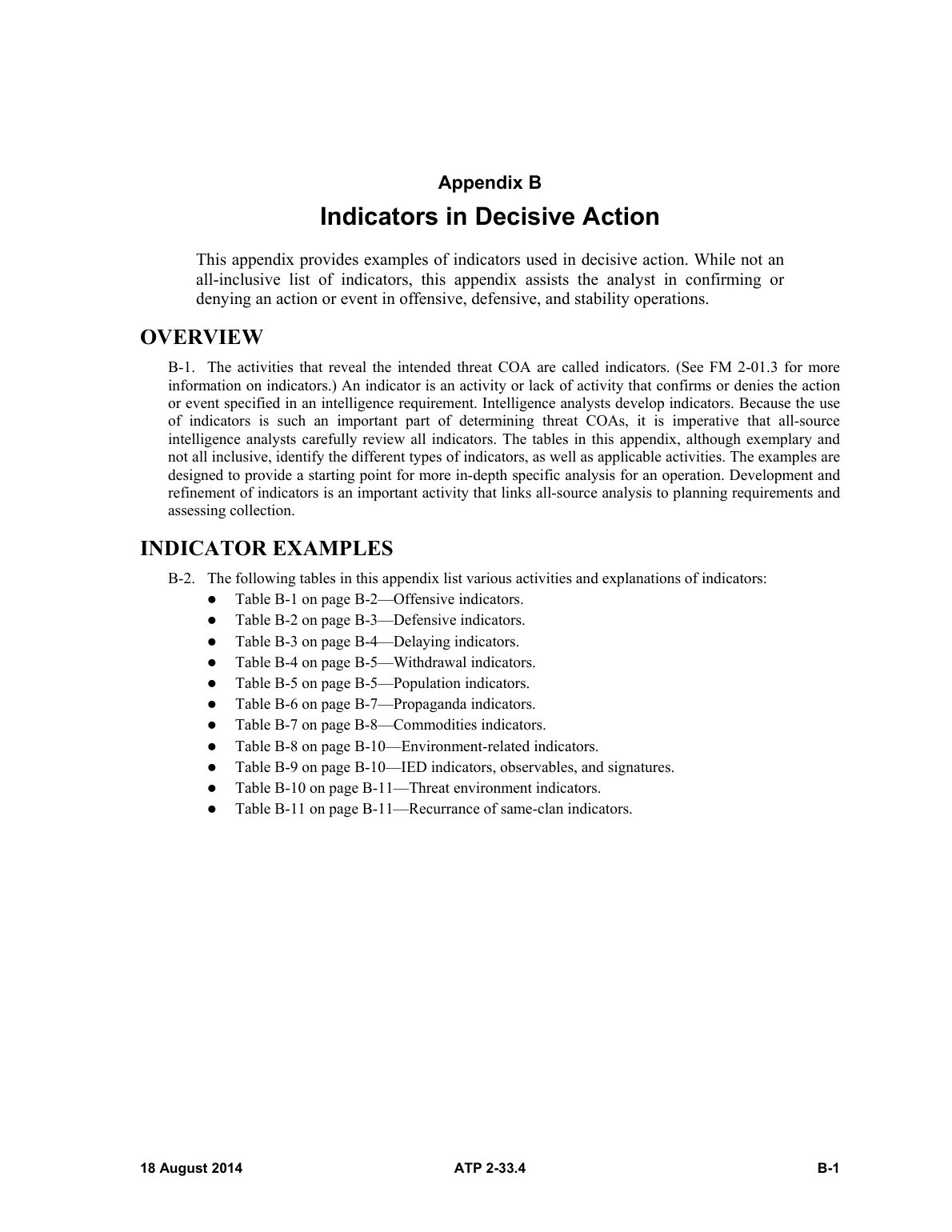
This appendix provides examples of indicators used in decisive action. While not an
all-inclusive list of indicators, this appendix assists the analyst in confirming or
denying an action or event in offensive, defensive, and stability operations.
OVERVIEW
B-1. The activities that reveal the intended threat COA are called indicators. (See FM 2-01.3 for more
information on indicators.) An indicator is an activity or lack of activity that confirms or denies the action
or event specified in an intelligence requirement. Intelligence analysts develop indicators. Because the use
of indicators is such an important part of determining threat COAs, it is imperative that all-source
intelligence analysts carefully review all indicators. The tables in this appendix, although exemplary and
not all inclusive, identify the different types of indicators, as well as applicable activities. The examples are
designed to provide a starting point for more in-depth specific analysis for an operation. Development and
refinement of indicators is an important activity that links all-source analysis to planning requirements and
assessing collection.
INDICATOR EXAMPLES
B-2. The following tables in this appendix list various activities and explanations of indicators:
Table B-1 on page B-2—Offensive indicators.
Table B-2 on page B-3—Defensive indicators.
Table B-3 on page B-4—Delaying indicators.
Table B-4 on page B-5—Withdrawal indicators.
Table B-5 on page B-5—Population indicators.
Table B-6 on page B-7—Propaganda indicators.
Table B-7 on page B-8—Commodities indicators.
Table B-8 on page B-10—Environment-related indicators.
Table B-9 on page B-10—IED indicators, observables, and signatures.
Table B-10 on page B-11—Threat environment indicators.
Table B-11 on page B-11—Recurrance of same-clan indicators.