ATP 2-33.4, page 126
Intelligence Analysis
Army Techniques Publication: Intelligence Analysis
2014 public edition (Archive.org)
Searchable page text (OCR / PDF)
Appendix B
B-2
ATP 2-33.4
18 August 2014
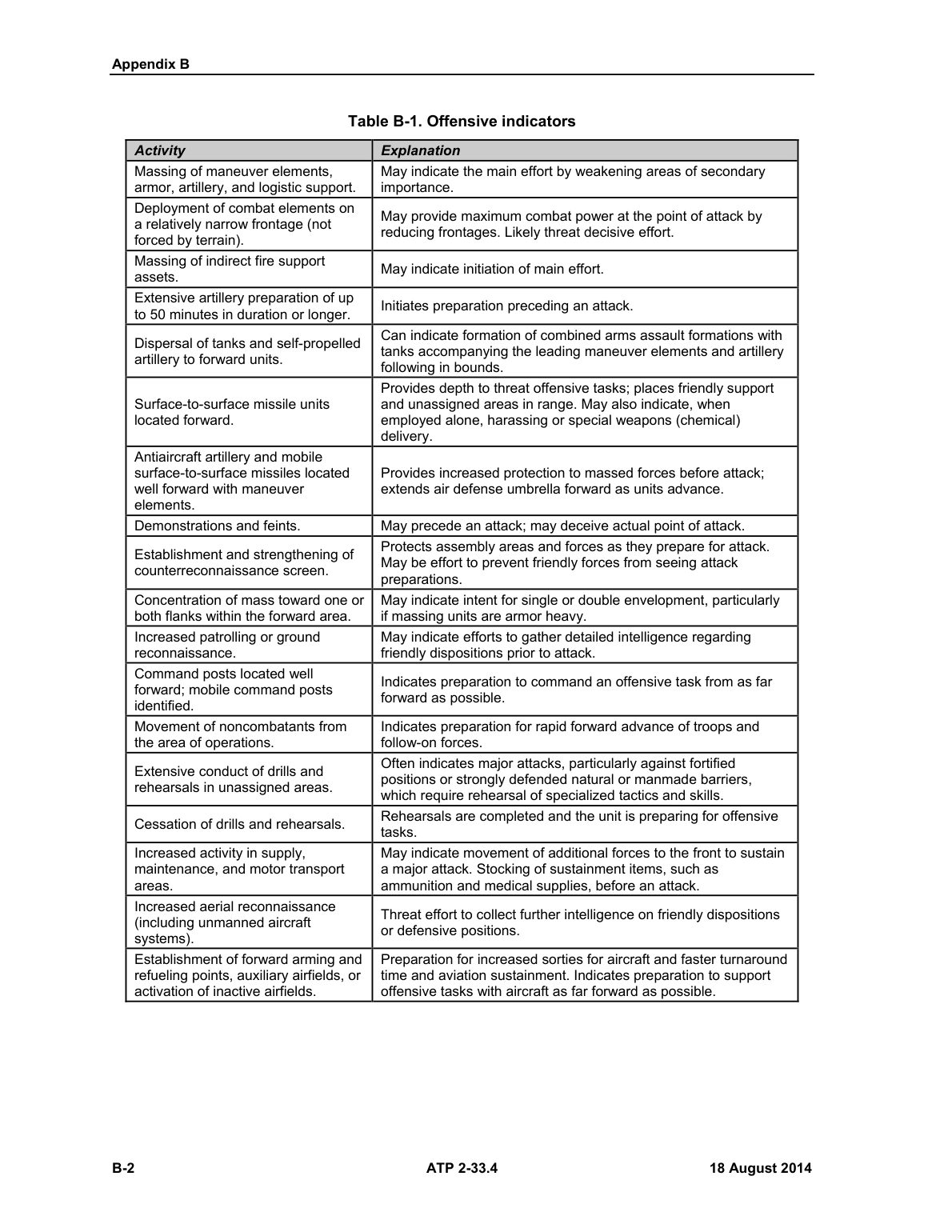
Table B-1. Offensive indicators
Activity
Explanation
Massing of maneuver elements,
armor, artillery, and logistic support.
May indicate the main effort by weakening areas of secondary
importance.
Deployment of combat elements on
a relatively narrow frontage (not
forced by terrain).
May provide maximum combat power at the point of attack by
reducing frontages. Likely threat decisive effort.
Massing of indirect fire support
assets.
May indicate initiation of main effort.
Extensive artillery preparation of up
to 50 minutes in duration or longer.
Initiates preparation preceding an attack.
Dispersal of tanks and self-propelled
artillery to forward units.
Can indicate formation of combined arms assault formations with
tanks accompanying the leading maneuver elements and artillery
following in bounds.
Surface-to-surface missile units
located forward.
Provides depth to threat offensive tasks; places friendly support
and unassigned areas in range. May also indicate, when
employed alone, harassing or special weapons (chemical)
delivery.
Antiaircraft artillery and mobile
surface-to-surface missiles located
well forward with maneuver
elements.
Provides increased protection to massed forces before attack;
extends air defense umbrella forward as units advance.
Demonstrations and feints.
May precede an attack; may deceive actual point of attack.
Establishment and strengthening of
counterreconnaissance screen.
Protects assembly areas and forces as they prepare for attack.
May be effort to prevent friendly forces from seeing attack
preparations.
Concentration of mass toward one or
both flanks within the forward area.
May indicate intent for single or double envelopment, particularly
if massing units are armor heavy.
Increased patrolling or ground
reconnaissance.
May indicate efforts to gather detailed intelligence regarding
friendly dispositions prior to attack.
Command posts located well
forward; mobile command posts
identified.
Indicates preparation to command an offensive task from as far
forward as possible.
Movement of noncombatants from
the area of operations.
Indicates preparation for rapid forward advance of troops and
follow-on forces.
Extensive conduct of drills and
rehearsals in unassigned areas.
Often indicates major attacks, particularly against fortified
positions or strongly defended natural or manmade barriers,
which require rehearsal of specialized tactics and skills.
Cessation of drills and rehearsals.
Rehearsals are completed and the unit is preparing for offensive
tasks.
Increased activity in supply,
maintenance, and motor transport
areas.
May indicate movement of additional forces to the front to sustain
a major attack. Stocking of sustainment items, such as
ammunition and medical supplies, before an attack.
Increased aerial reconnaissance
(including unmanned aircraft
systems).
Threat effort to collect further intelligence on friendly dispositions
or defensive positions.
Establishment of forward arming and
refueling points, auxiliary airfields, or
activation of inactive airfields.
Preparation for increased sorties for aircraft and faster turnaround
time and aviation sustainment. Indicates preparation to support
offensive tasks with aircraft as far forward as possible.