ATP 2-33.4, page 129
Intelligence Analysis
Army Techniques Publication: Intelligence Analysis
2014 public edition (Archive.org)
Searchable page text (OCR / PDF)
Indicators in Decisive Action
18 August 2014
ATP 2-33.4
B-5
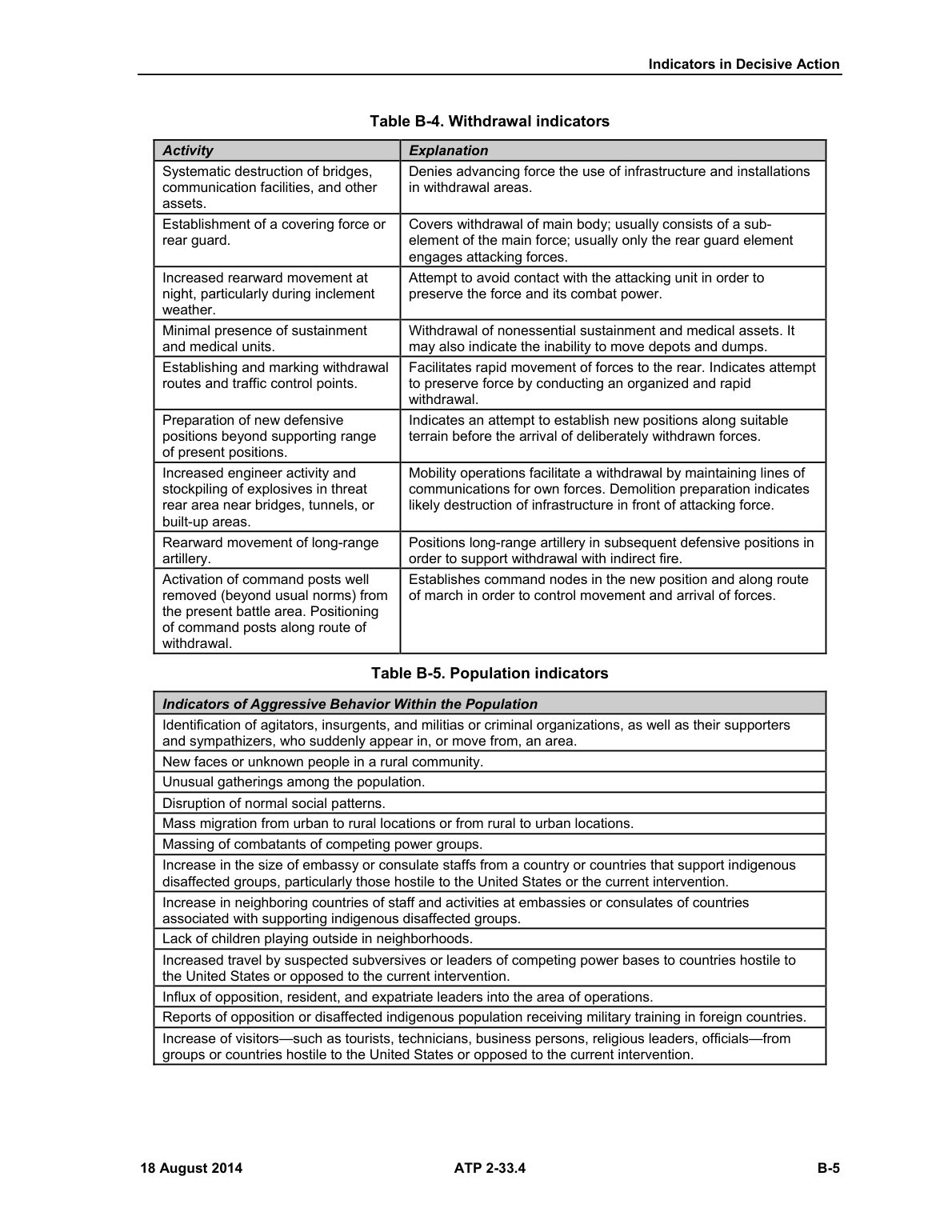
Table B-4. Withdrawal indicators
Activity
Explanation
Systematic destruction of bridges,
communication facilities, and other
assets.
Denies advancing force the use of infrastructure and installations
in withdrawal areas.
Establishment of a covering force or
rear guard.
Covers withdrawal of main body; usually consists of a sub-
element of the main force; usually only the rear guard element
engages attacking forces.
Increased rearward movement at
night, particularly during inclement
weather.
Attempt to avoid contact with the attacking unit in order to
preserve the force and its combat power.
Minimal presence of sustainment
and medical units.
Withdrawal of nonessential sustainment and medical assets. It
may also indicate the inability to move depots and dumps.
Establishing and marking withdrawal
routes and traffic control points.
Facilitates rapid movement of forces to the rear. Indicates attempt
to preserve force by conducting an organized and rapid
withdrawal.
Preparation of new defensive
positions beyond supporting range
of present positions.
Indicates an attempt to establish new positions along suitable
terrain before the arrival of deliberately withdrawn forces.
Increased engineer activity and
stockpiling of explosives in threat
rear area near bridges, tunnels, or
built-up areas.
Mobility operations facilitate a withdrawal by maintaining lines of
communications for own forces. Demolition preparation indicates
likely destruction of infrastructure in front of attacking force.
Rearward movement of long-range
artillery.
Positions long-range artillery in subsequent defensive positions in
order to support withdrawal with indirect fire.
Activation of command posts well
removed (beyond usual norms) from
the present battle area. Positioning
of command posts along route of
withdrawal.
Establishes command nodes in the new position and along route
of march in order to control movement and arrival of forces.
Table B-5. Population indicators
Indicators of Aggressive Behavior Within the Population
Identification of agitators, insurgents, and militias or criminal organizations, as well as their supporters
and sympathizers, who suddenly appear in, or move from, an area.
New faces or unknown people in a rural community.
Unusual gatherings among the population.
Disruption of normal social patterns.
Mass migration from urban to rural locations or from rural to urban locations.
Massing of combatants of competing power groups.
Increase in the size of embassy or consulate staffs from a country or countries that support indigenous
disaffected groups, particularly those hostile to the United States or the current intervention.
Increase in neighboring countries of staff and activities at embassies or consulates of countries
associated with supporting indigenous disaffected groups.
Lack of children playing outside in neighborhoods.
Increased travel by suspected subversives or leaders of competing power bases to countries hostile to
the United States or opposed to the current intervention.
Influx of opposition, resident, and expatriate leaders into the area of operations.
Reports of opposition or disaffected indigenous population receiving military training in foreign countries.
Increase of visitors—such as tourists, technicians, business persons, religious leaders, officials—from
groups or countries hostile to the United States or opposed to the current intervention.