Advanced search

About 49 results · showing 1–20 · page 1 of 3 · Edit filters

Intelligence Analysis
Military manual · ATP 2-33.4

ATP 2-33.4, page 89

Intelligence Analysis

Army Techniques Publication: Intelligence Analysis

…Some situations (particularly crisis-response operations) may require analysts to focus primarily upon the effects of terrain and weather, as in the case of natural disasters or upon the resulting human catastrophe after a natural disaster…
Joint Operations
Military manual · JP 3-0

JP 3-0, page 67

Joint Operations

Joint Publication: Joint Operations

…Safety planning factors could include geospatial and weather data, local road conditions and driving habits, uncharted or uncleared mine fields, and special equipment hazards. (2) To assist in risk management, commanders and their staffs may develop…
Joint Operations
Military manual · JP 3-0

JP 3-0, page 148

Joint Operations

Joint Publication: Joint Operations

…Physical Environment (1) Weather, terrain, and sea conditions can significantly affect operations and logistic support of the joint force and should be carefully assessed before sustained combat operations. Mobility of the force, integration and synchronization of…
Intelligence Analysis
Military manual · ATP 2-33.4

ATP 2-33.4, page 129

Intelligence Analysis

Army Techniques Publication: Intelligence Analysis

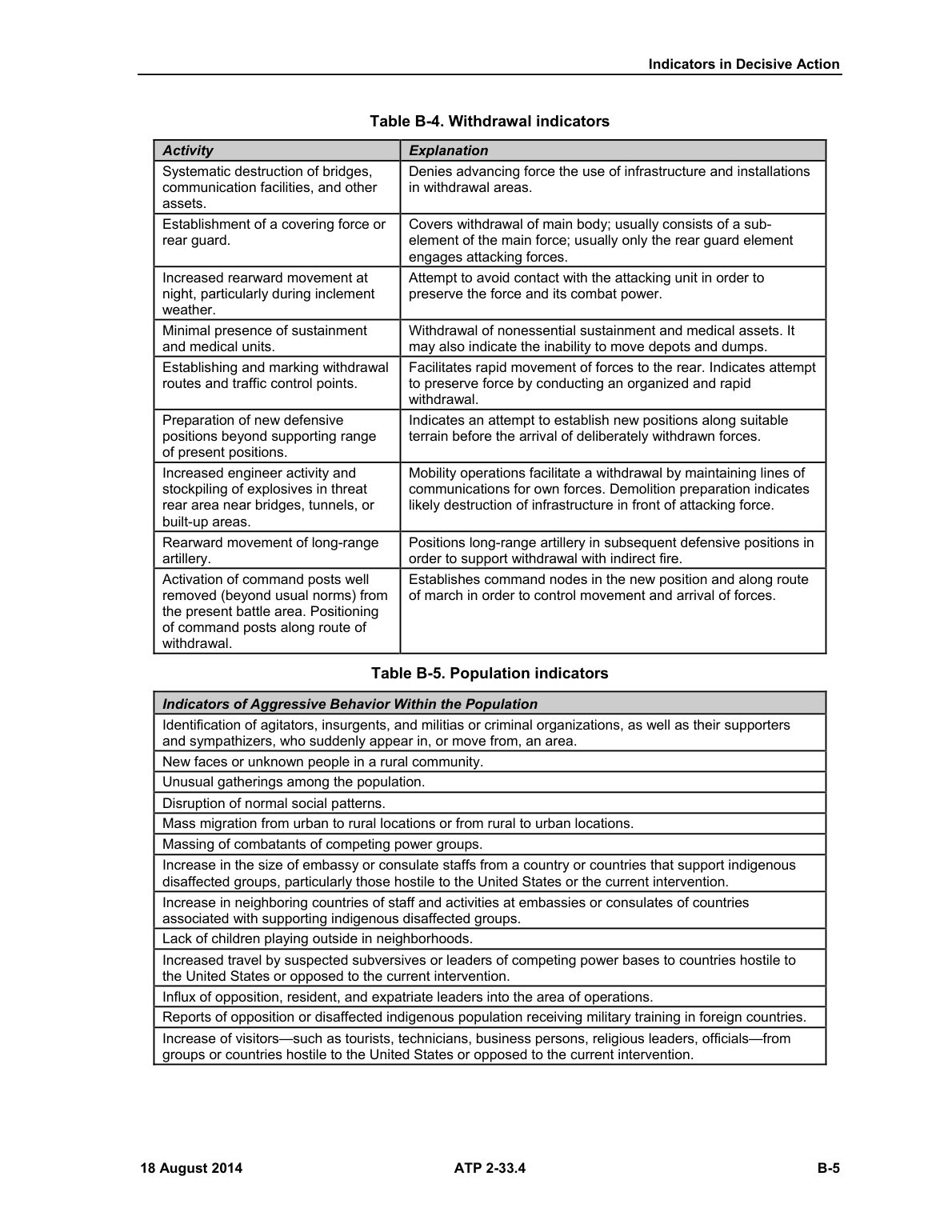
…Increased rearward movement at night, particularly during inclement weather. Attempt to avoid contact with the attacking unit in order to preserve the force and its combat power. Minimal presence of sustainment and medical units. Withdrawal of…
Targeting
Military manual · AFDD 2-1.9

AFDD 2-1.9, page 61

Targeting

Air Force Doctrine Document: Targeting

…Target location and other information must be refined enough to permit engagement, which requires ISR capabilities that can identify stationary and mobile targets, day or night, in all weather, through all forms of terrain, camouflage, and…
Joint Operations
Military manual · JP 3-0

JP 3-0, page 154

Joint Operations

Joint Publication: Joint Operations

…Space superiority allows the JFC access to communications, weather, navigation, timing, remote sensing, and ISR assets without prohibitive interference by the opposing force. Space control operations are conducted by joint and allied and/or coalition forces…
Intelligence Analysis
Military manual · ATP 2-33.4

ATP 2-33.4, page 15

Intelligence Analysis

Army Techniques Publication: Intelligence Analysis

…DCGS-A provides a network-centric, enterprise intelligence, weather, geospatial engineering, and space operations capabilities to maneuver, maneuver support, and sustainment organization at all echelons from battalion to joint task forces. The DCGS-A integrates intelligence…
Targeting
Military manual · AFDD 2-1.9

AFDD 2-1.9, page 113

Targeting

Air Force Doctrine Document: Targeting

…Products include controlled imagery, digital elevation data and selected feature information, which can be rapidly augmented and fused with other spatially referenced information such as intelligence, weather, and logistics data resulting in an integrated, digital view…
Joint Operations
Military manual · JP 3-0

JP 3-0, page 94

Joint Operations

Joint Publication: Joint Operations

…These factors include terrain (including urban settings), weather, topography, hydrology, EMS, and other environmental conditions in the operational area; distances associated with the deployment to the operational area and employment of joint capabilities; the location of…
Targeting
Military manual · AFDP 3-60

AFDP 3-60, page 39

Targeting

Air Force Doctrine Publication: Targeting

Air Force Doctrine Publication 3-60, Targeting 36 high-accuracy, all-weather, day-or-night strikes against ground targets. Air Force Global Strike Command (AFGSC) is a component MAJCOM of USSTRATCOM. AFGSC provides combat ready forces…
Joint Targeting
Military manual · JP 3-60

JP 3-60, page 90

Joint Targeting

Joint Publication: Joint Targeting

…The extent of danger to the civilian population varies with the type of military target attacked, terrain, weapons used, weather, and civilian proximity. b. Threats to civilians depend on engagement techniques, weapons used, nature of conflict…
Targeting
Military manual · AFDD 2-1.9

AFDD 2-1.9, page 62

Targeting

Air Force Doctrine Document: Targeting

…The selection of assets for a specific target will be based on many factors, such as the location and operational status of ISR and strike assets, support asset availability, weather conditions, ROE, target range, the number…
Joint Targeting
Military manual · JP 3-60

JP 3-60, page 67

Joint Targeting

Joint Publication: Joint Targeting

…Operations, plans, and intelligence personnel are the primary participants, but other functional area (e.g., logistics, weather, legal, and communications) subject matter experts (SMEs) also support the joint targeting cycle. Therefore, the organizational structure established by…
Targeting
Military manual · AFDP 3-60

AFDP 3-60, page 37

Targeting

Air Force Doctrine Publication: Targeting

…Sixteenth Air Force (16 AF) leverages ISR, cyberspace operations, electromagnetic warfare, weather, public affairs, and information capabilities to provide multi-source intelligence, targeting support, and mission integration support to the USAF targeting enterprise, as well as…
Targeting
Military manual · AFDP 3-60

AFDP 3-60, page 28

Targeting

Air Force Doctrine Publication: Targeting

…During force execution, the OE changes due to factors such as weather fluctuations and the enemy response to friendly actions. The senior intelligence duty officer (SIDO) in the COD monitors the enemy during execution and provides…
Targeting
Military manual · AFDD 2-1.9

AFDD 2-1.9, page 54

Targeting

Air Force Doctrine Document: Targeting

…Normally, targeting changes are needed due to adverse weather, assessment requirements, or modification of priorities. The ability to quickly recommend good alternate targets is very important to the flexibility of air and space power. Combat operations…
Targeting
Military manual · AFDD 2-1.9

AFDD 2-1.9, page 52

Targeting

Air Force Doctrine Document: Targeting

…These instructions should also consider the volume of friendly air traffic, friendly air defense requirements, identification friend or foe technology, weather, and adversary capabilities. Instructions contained in the SPINS and the ACO are updated as frequently…
Joint Operations
Military manual · JP 3-0

JP 3-0, page 82

Joint Operations

Joint Publication: Joint Operations

…Force protection does not include actions to defeat the enemy or protect against accidents, weather, or disease. Force health protection (FHP)
Targeting
Military manual · AFDD 2-1.9

AFDD 2-1.9, page 129

Targeting

Air Force Doctrine Document: Targeting

119 intensity conflict assessment, weather effects, and logistic status. Formerly known (in less comprehensive form) as combat assessment or CA. Also called TA (AFDD 2-1.9) tactical control. Command authority over assigned or attached forces…
Targeting
Military manual · AFDP 3-60

AFDP 3-60, page 8

Targeting

Air Force Doctrine Publication: Targeting

…They include factors such as weather, terrain, camouflage, and the civilian environment, all of which can influence engagement tactics and weapon selection. Temporal. These describe the target’s vulnerability to detection, engagement, or attack in relation…