About 98 results · showing 1–20 · page 1 of 5

Intelligence Analysis
Military manual · ATP 2-33.4

ATP 2-33.4, page 79

Intelligence Analysis

Army Techniques Publication: Intelligence Analysis

…Conducting pattern analysis is an analytical technique that aids intelligence personnel in determining possible enemy future actions when there is little or no near real-time information available concerning enemy location, disposition, movement, or objectives. For…
Intelligence Analysis
Military manual · ATP 2-33.4

ATP 2-33.4, page 22

Intelligence Analysis

Army Techniques Publication: Intelligence Analysis

…They wander into side issues that may be intellectually satisfying to discuss but have no bearing on the issue or question. © Standard 5—Depth. We think deeply when we get beneath the surface of an issue…
Intelligence Analysis
Military manual · ATP 2-33.4

ATP 2-33.4, page 80

Intelligence Analysis

Army Techniques Publication: Intelligence Analysis

…The analyst must be careful not to assume that events following earlier events are caused by the earlier events; there may be no causal relationship involved. The value of this tool can be reduced if the…
Intelligence Analysis
Military manual · ATP 2-33.4

ATP 2-33.4, page 112

Intelligence Analysis

Army Techniques Publication: Intelligence Analysis

… Never censor an analyst’s ideas no matter how unconventional they might sound.  Find out what prompted the thought, as it might contain the seeds of an important connection between the topic and an…
Intelligence Analysis
Military manual · ATP 2-33.4

ATP 2-33.4, page 56

Intelligence Analysis

Army Techniques Publication: Intelligence Analysis

…Some of the simple rules to be followed include—  Never censor an analyst’s ideas no matter how unconventional they might sound.  Find out what prompted the thought, as it might contain the seeds…
Intelligence Analysis
Military manual · ATP 2-33.4

ATP 2-33.4, page 108

Intelligence Analysis

Army Techniques Publication: Intelligence Analysis

…Like other contrarian methods, “what if” analysis must begin by stating the conventional analytic line and then stepping back to consider what alternative outcomes are too important to dismiss, no matter how unlikely.
Intelligence Analysis
Military manual · ATP 2-33.4

ATP 2-33.4, page 102

Intelligence Analysis

Army Techniques Publication: Intelligence Analysis

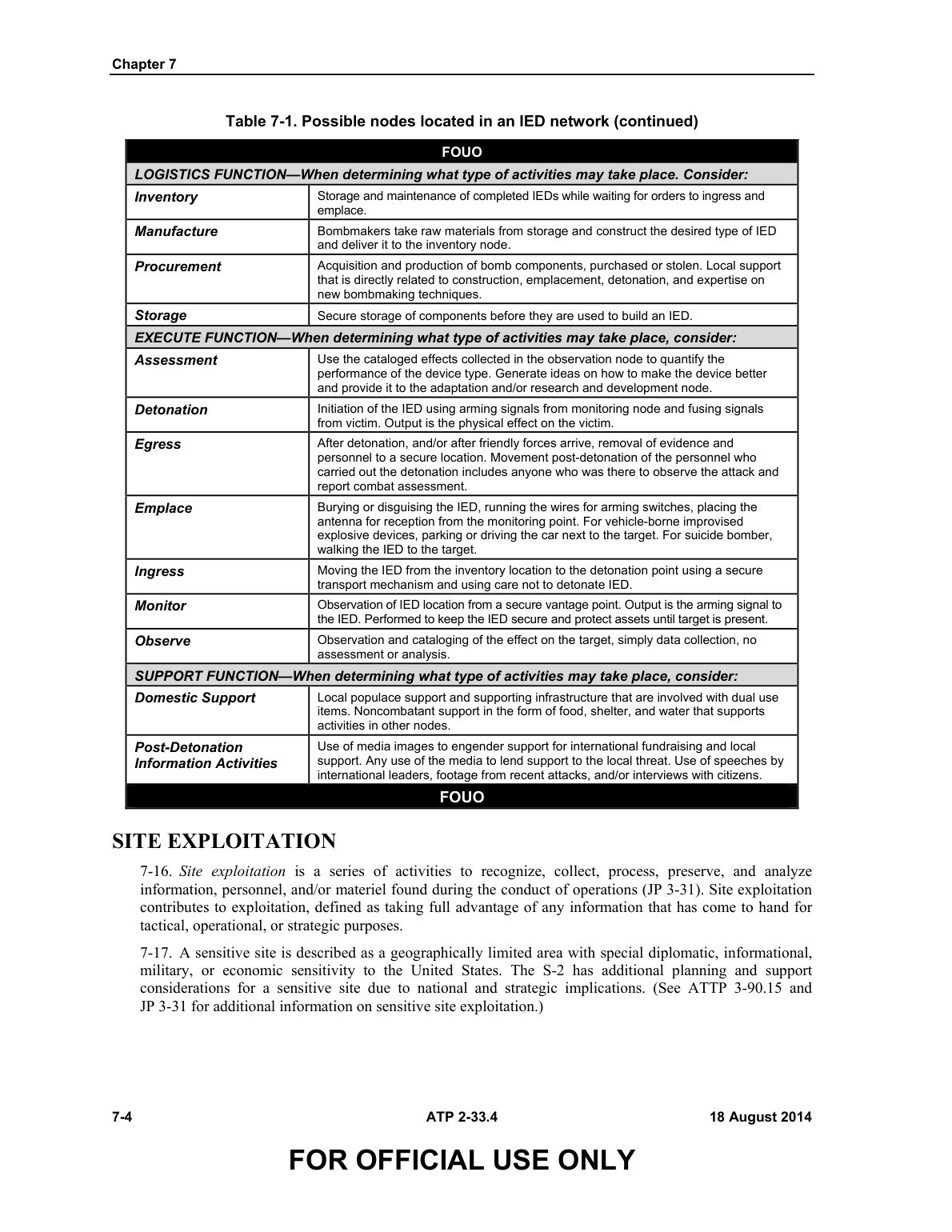
…Observe Observation and cataloging of the effect on the target, simply data collection, no assessment or analysis. SUPPORT FUNCTION—When determining what type of activities may take place, consider: Domestic Support Local populace support and supporting…
Joint Targeting
Military manual · JP 3-60

JP 3-60, page 88

Joint Targeting

Joint Publication: Joint Targeting

…For additional information on NSLs and CDE methodology reference CJCSI 3160.01, No Strike and the Collateral Damage Estimation Methodology. Joint force targeting during such situations is driven by the principle of proportionality, so that otherwise…
Intelligence Analysis
Military manual · ATP 2-33.4

ATP 2-33.4, page 115

Intelligence Analysis

Army Techniques Publication: Intelligence Analysis

…It is best used when—  There is little to no information available and surprise conditions are ripe.  There is a need to identify that threat variations exists.  The analyst needs to specifically understand…
Joint Operations
Military manual · JP 3-0

JP 3-0, page 163

Joint Operations

Joint Publication: Joint Operations

…An enemy may use WMD against other multinational partners, especially those with little or no defense against these weapons, to disintegrate the alliance or coalition. (a) Intelligence and other joint staff members advise JFCs of an…
Joint Targeting
Military manual · JP 3-60

JP 3-60, page 44

Joint Targeting

Joint Publication: Joint Targeting

…For example, a lethal weapon might be able to neutralize a particular target’s function, but because the target is located in a country for which we have no (and would not receive approval for) lethal…
Joint Operations
Military manual · JP 3-0

JP 3-0, page 67

Joint Operations

Joint Publication: Joint Operations

…Risk management does not inhibit a commander’s flexibility and initiative; remove risk altogether (or support a zero-defects mindset); dictate a GO/NO-GO decision to take a specific action; sanction or justify violating the…
Joint Operations
Military manual · JP 3-0

JP 3-0, page 168

Joint Operations

Joint Publication: Joint Operations

…Personnel should stay alert even in an operation with little or no perceived risk. JFCs must take measures to prevent complacency and be ready to counter activity that could bring harm to units or jeopardize the…
Targeting
Military manual · AFDD 2-1.9

AFDD 2-1.9, page 29

Targeting

Air Force Doctrine Document: Targeting

…A direct effect is the first-order result of action with no intervening mechanism between act and outcome—usually immediate and empirically verifiable, like the results of weapons employment. Indirect effects are more complicated. An indirect…
Joint Operations
Military manual · JP 3-0

JP 3-0, page 59

Joint Operations

Joint Publication: Joint Operations

…Thus the SCA typically has no role in prioritizing the JFC’s day-to-day space force enhancement requirements. The SCA gathers operational requirements that may be satisfied by space capabilities and facilitates the use of…
Intelligence Analysis
Military manual · ATP 2-33.4

ATP 2-33.4, page 106

Intelligence Analysis

Army Techniques Publication: Intelligence Analysis

…There is no prescribed procedure, but the following steps should be followed at a minimum:  Outline the main points and key assumptions and characterize the evidence supporting current analytic view.  Select one or more…
Targeting
Military manual · AFDP 3-60

AFDP 3-60, page 35

Targeting

Air Force Doctrine Publication: Targeting

…CDE analysts should apply the specific guidance and data in CJCSI 3160.01D, No-Strike and CDE Methodology. Joint Automated Deep Operations Coordination System (JADOCS). JADOCS is an Army-developed mission management software application used by…
Targeting
Military manual · AFDD 2-1.9

AFDD 2-1.9, page 44

Targeting

Air Force Doctrine Document: Targeting

…Other products may include creation of or additions to no-strike or restricted target lists (see “products of the phase,” below). Target research within the tasking cycle often entails studying previously unidentified or unlocated targets. Responsibility…
Joint Targeting
Military manual · JP 3-60

JP 3-60, page 46

Joint Targeting

Joint Publication: Joint Targeting

…CJCSI 3160.01, No-Strike and the Collateral Damage Estimation Methodology details a specific CDE process followed Department of Defense (DOD)-wide. Targets with associated collateral damage concerns expected to exceed theater (combatant command) thresholds are…
Joint Targeting
Military manual · JP 3-60

JP 3-60, page 113

Joint Targeting

Joint Publication: Joint Targeting

…Assessments of NO DAMAGE or DESTROYED are easily defined and understandable. The difficulty comes in subjective judgment specifying the level of damage between these two extremes. Intermediate damage definitions are dependent on target type and the…