Advanced search

generals

About 199 results · showing 161–180 · page 9 of 10 · Edit filters

Joint Targeting
Military manual · JP 3-60

JP 3-60, page 48

Joint Targeting

Joint Publication: Joint Targeting

…During force assignment, targeteers also provide updated target status, effectiveness analysis, and collateral damage estimates. (4) Five General Steps in Force Assignment (a) Consolidate Target Development and Capabilities Analysis Results. In this step, targeting personnel assemble…
Joint Targeting
Military manual · JP 3-60

JP 3-60, page 39

Joint Targeting

Joint Publication: Joint Targeting

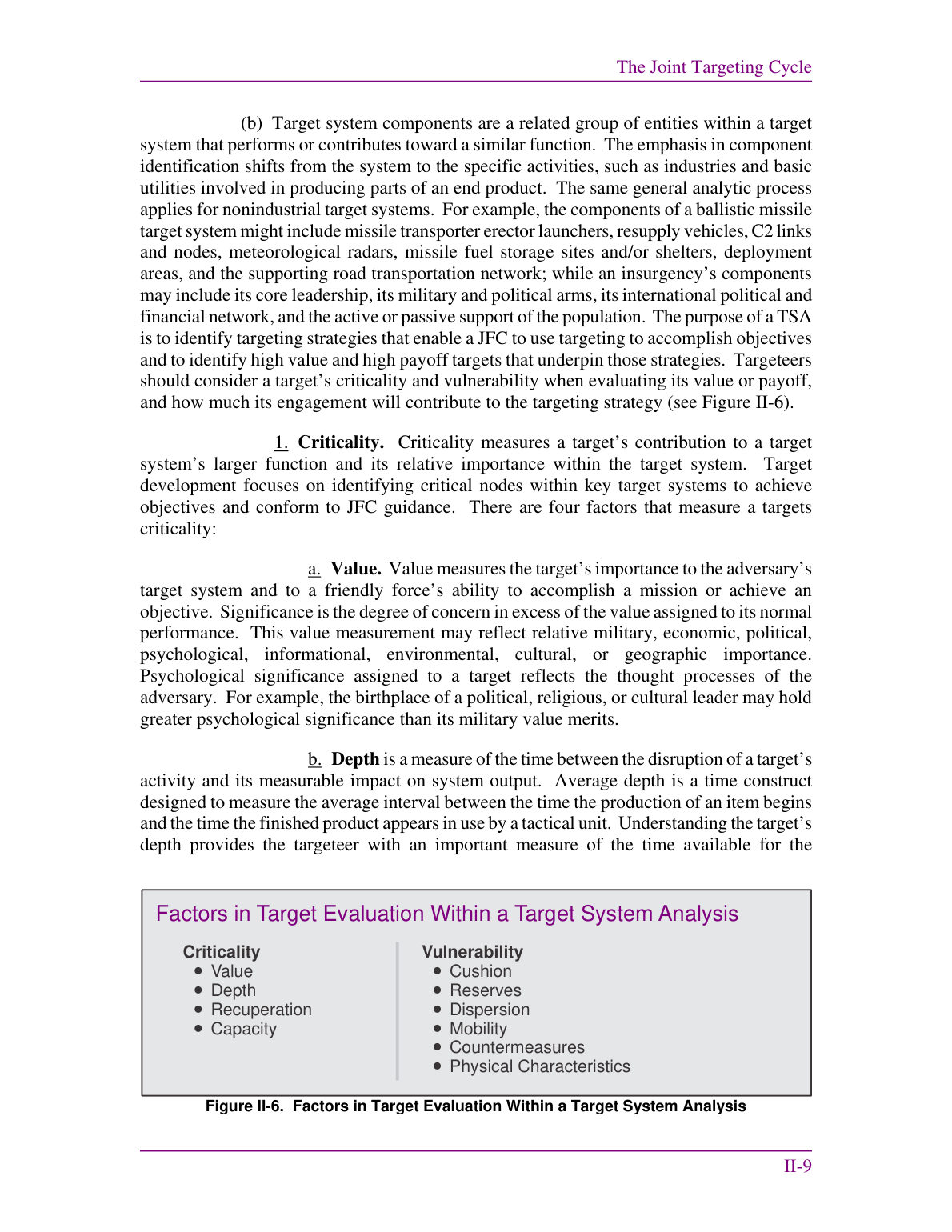
…The same general analytic process applies for nonindustrial target systems. For example, the components of a ballistic missile target system might include missile transporter erector launchers, resupply vehicles, C2 links and nodes, meteorological radars, missile fuel…
Targeting
Military manual · AFDD 2-1.9

AFDD 2-1.9, page 28

Targeting

Air Force Doctrine Document: Targeting

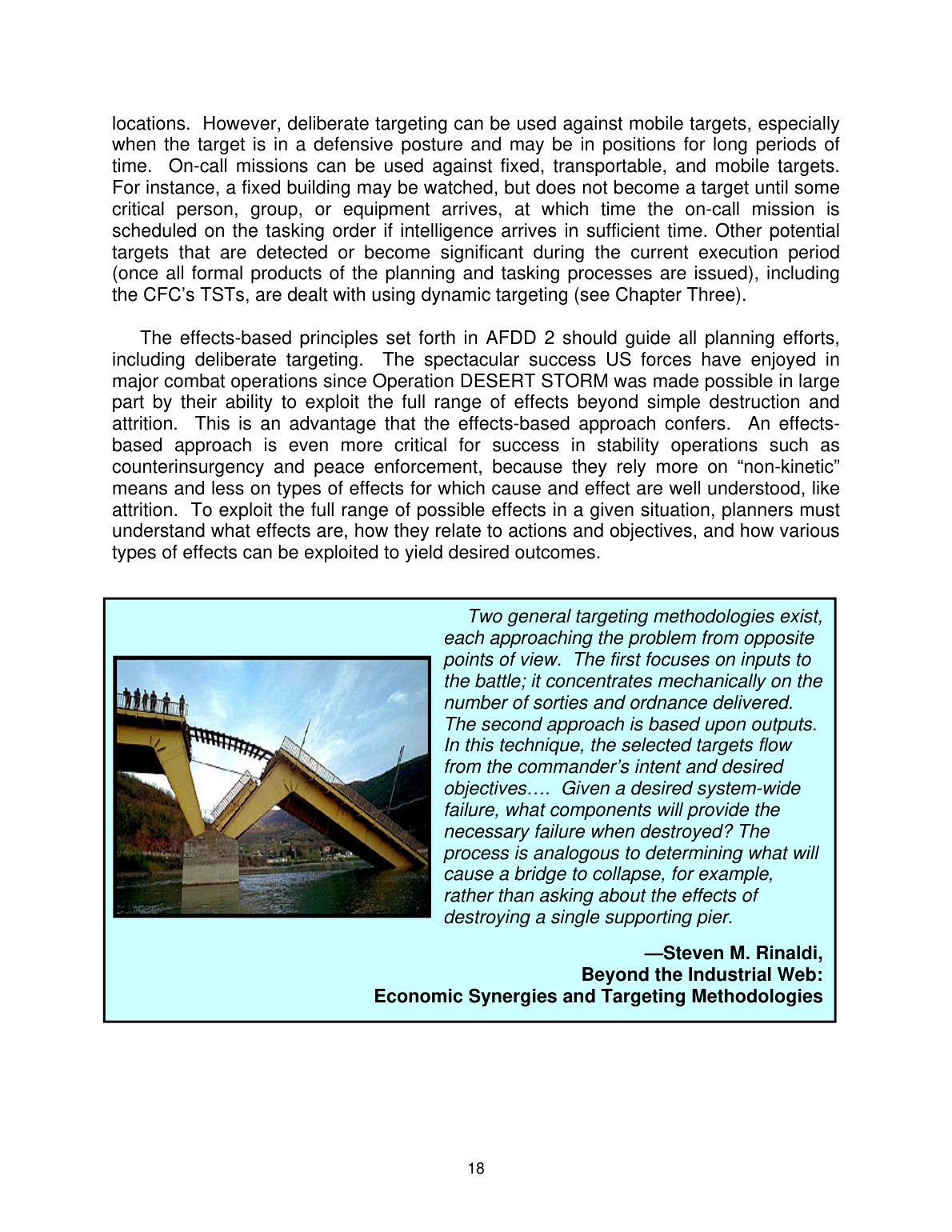
…Two general targeting methodologies exist, each approaching the problem from opposite points of view. The first focuses on inputs to the battle; it concentrates mechanically on the number of sorties and ordnance delivered. The second approach…
Targeting
Military manual · AFDD 2-1.9

AFDD 2-1.9, page 5

Targeting

Air Force Doctrine Document: Targeting

…17 General...................................................................................................................................... 17 Effects-Based Considerations for Planning.............................................................................. 19 Targeting Responsibilities During Formal Planning ................................................................ 20 The Tasking Cycle and Deliberate Targeting........................................................................... 23 Air Tasking Cycle Phases and Their Products.......................................................................... 29 Objectives, Effects, and Guidance........................................................................................ 29 Target…
Targeting
Military manual · AFDP 3-60

AFDP 3-60, page 7

Targeting

Air Force Doctrine Publication: Targeting

…In general, targets are defined by five characteristics: physical, functional, cognitive control and information, environmental, and temporal.11 Physical. These are features discernible to one or more of the five senses or through sensor-derived signature…
Intelligence Analysis
Military manual · ATP 2-33.4

ATP 2-33.4, page 112

Intelligence Analysis

Army Techniques Publication: Intelligence Analysis

…In particular, the process involves a divergent thinking phase to generate and collect new ideas and insights, followed by a convergent phase in which ideas are grouped and organized around key concepts. The following are some…
Targeting
Military manual · AFDD 2-1.9

AFDD 2-1.9, page 4

Targeting

Air Force Doctrine Document: Targeting

…JACKSON Brigadier General, USAF Commander, Headquarters Air Force Doctrine Center
Targeting
Military manual · AFDD 2-1.9

AFDD 2-1.9, page 43

Targeting

Air Force Doctrine Document: Targeting

…It determines the necessary type, breadth, and duration of action that must be exerted on each target to generate effects that are consistent with the commander’s objectives.
Intelligence Analysis
Military manual · ATP 2-33.4

ATP 2-33.4, page 91

Intelligence Analysis

Army Techniques Publication: Intelligence Analysis

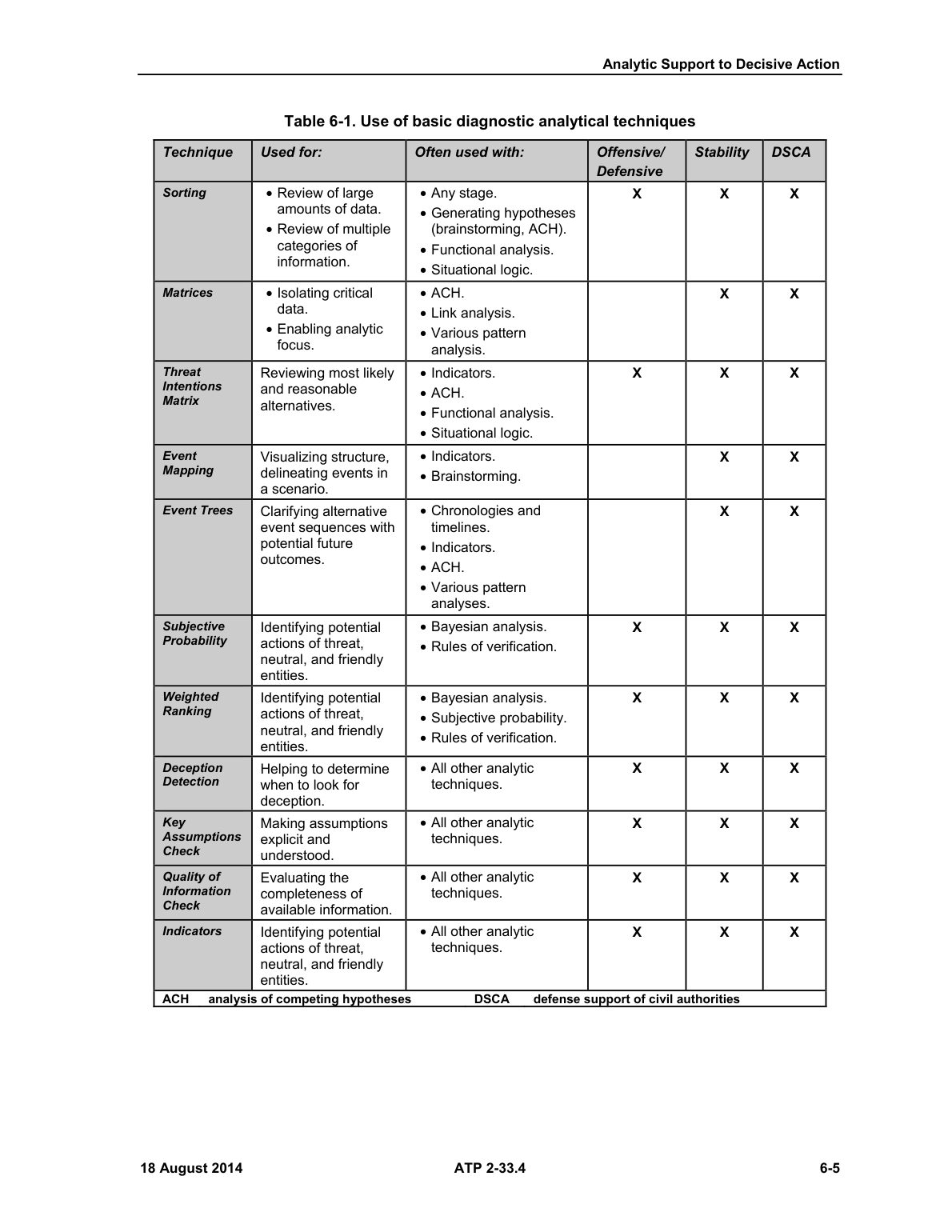
…Offensive/ Defensive Stability DSCA Sorting • Review of large amounts of data. • Review of multiple categories of information. • Any stage. • Generating hypotheses (brainstorming, ACH). • Functional analysis. • Situational logic. X X X Matrices • Isolating critical data. • Enabling analytic…
Joint Targeting
Military manual · JP 3-60

JP 3-60, page 45

Joint Targeting

Joint Publication: Joint Targeting

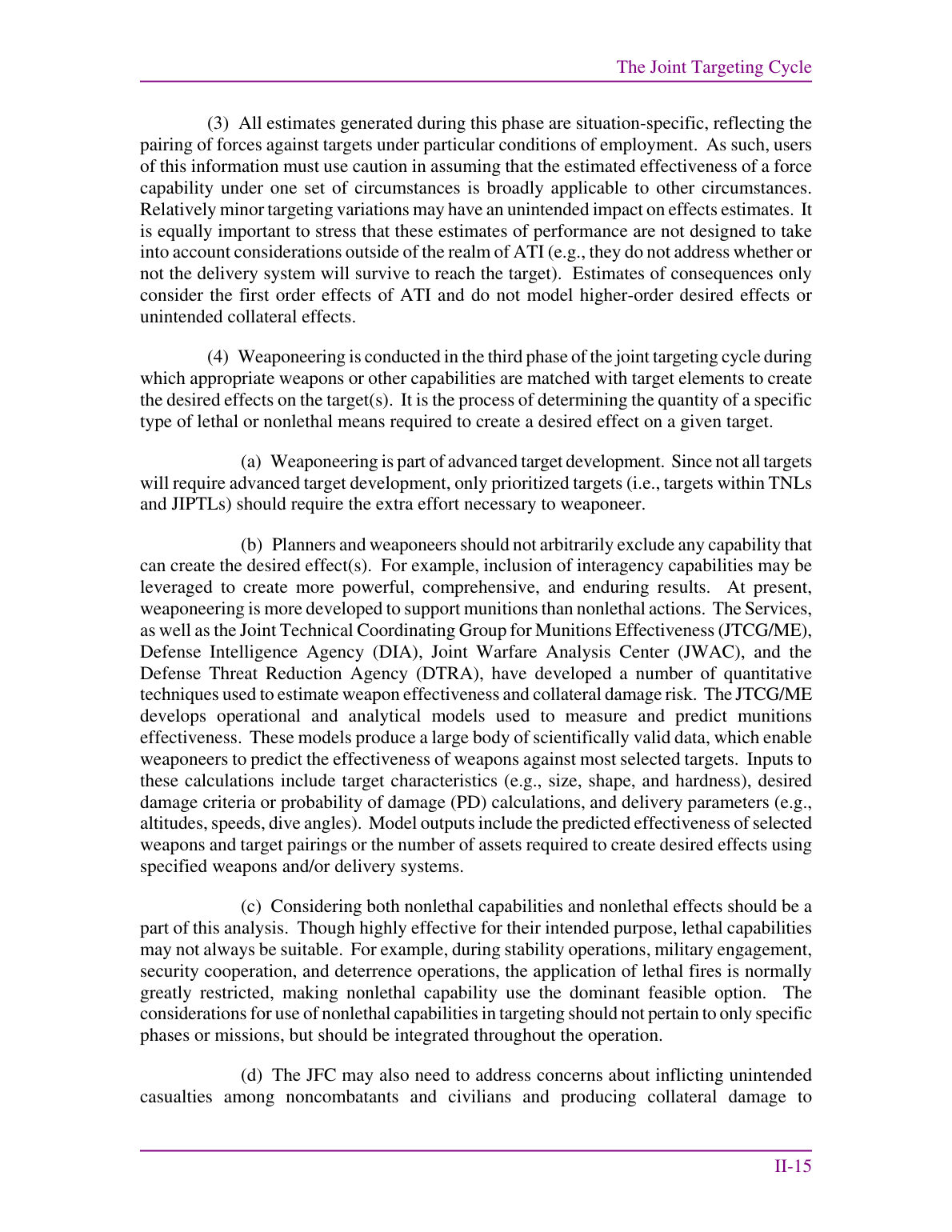
The Joint Targeting Cycle II-15 (3) All estimates generated during this phase are situation-specific, reflecting the pairing of forces against targets under particular conditions of employment. As such, users of this information must use…
Targeting
Military manual · AFDD 2-1.9

AFDD 2-1.9, page 67

Targeting

Air Force Doctrine Document: Targeting

57 CHAPTER FOUR ASSESSMENT GENERAL Assessment encompasses all efforts to evaluate effects and gauge progress toward accomplishment of actions, effects, and objectives. It also helps evaluate requirements for future action. It helps answer two questions: “How…
Targeting
Military manual · AFDD 2-1.9

AFDD 2-1.9, page 50

Targeting

Air Force Doctrine Document: Targeting

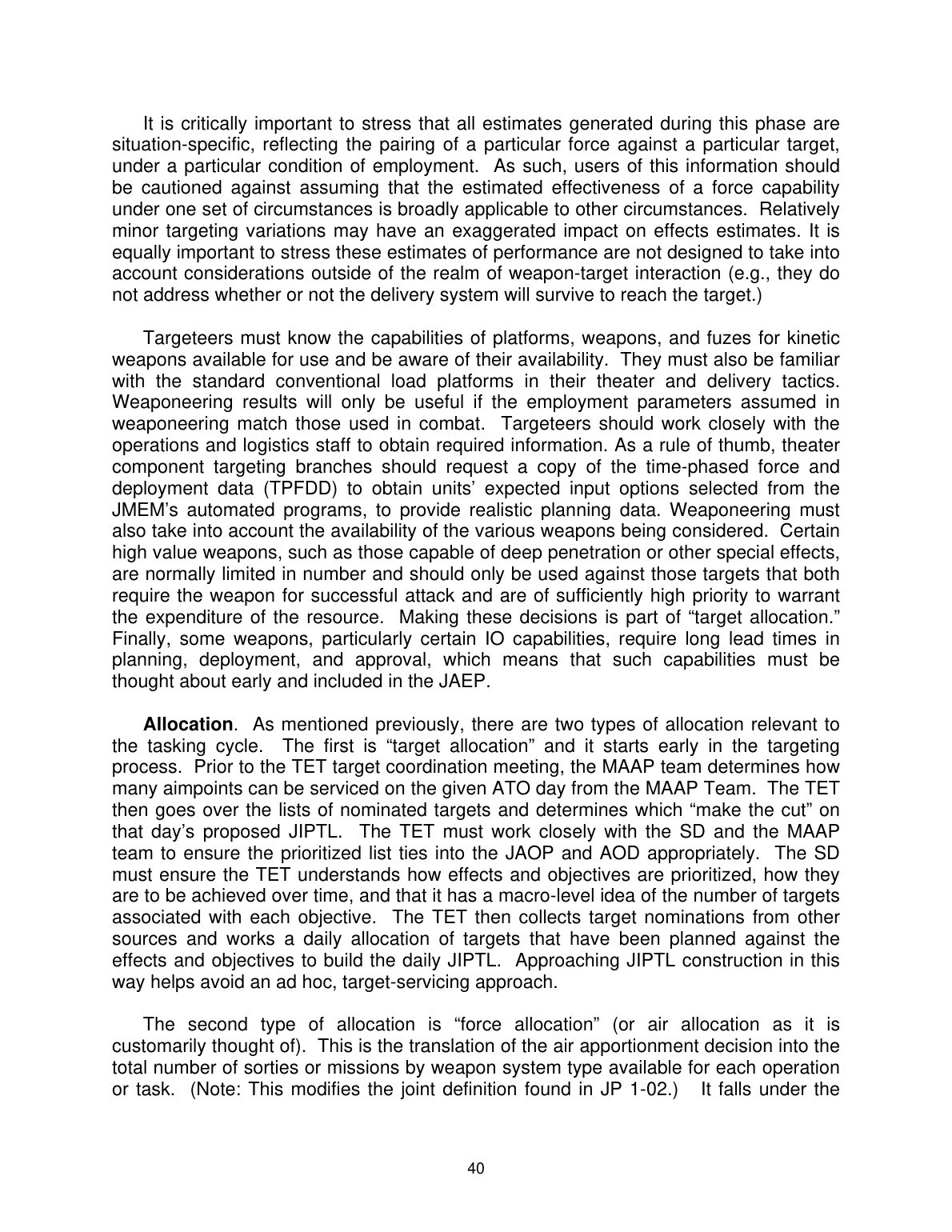
40 It is critically important to stress that all estimates generated during this phase are situation-specific, reflecting the pairing of a particular force against a particular target, under a particular condition of employment. As such…
Intelligence Analysis
Military manual · ATP 2-33.4

ATP 2-33.4, page 62

Intelligence Analysis

Army Techniques Publication: Intelligence Analysis

…This involves generating different hypotheses on the basis of considering concrete elements of the current situation. Broad, global generalizations are avoided. Even though most analysts know this to be untrue, every situation is treated as one…
Targeting
Military manual · AFDD 2-1.9

AFDD 2-1.9, page 29

Targeting

Air Force Doctrine Document: Targeting

…Parallel effects are generally preferable to sequential effects when it is possible to impose them. Full understanding of the types of effects and the principles of effects-based thinking can offer commanders more options, hasten success…
Targeting
Military manual · AFDD 2-1.9

AFDD 2-1.9, page 122

Targeting

Air Force Doctrine Document: Targeting

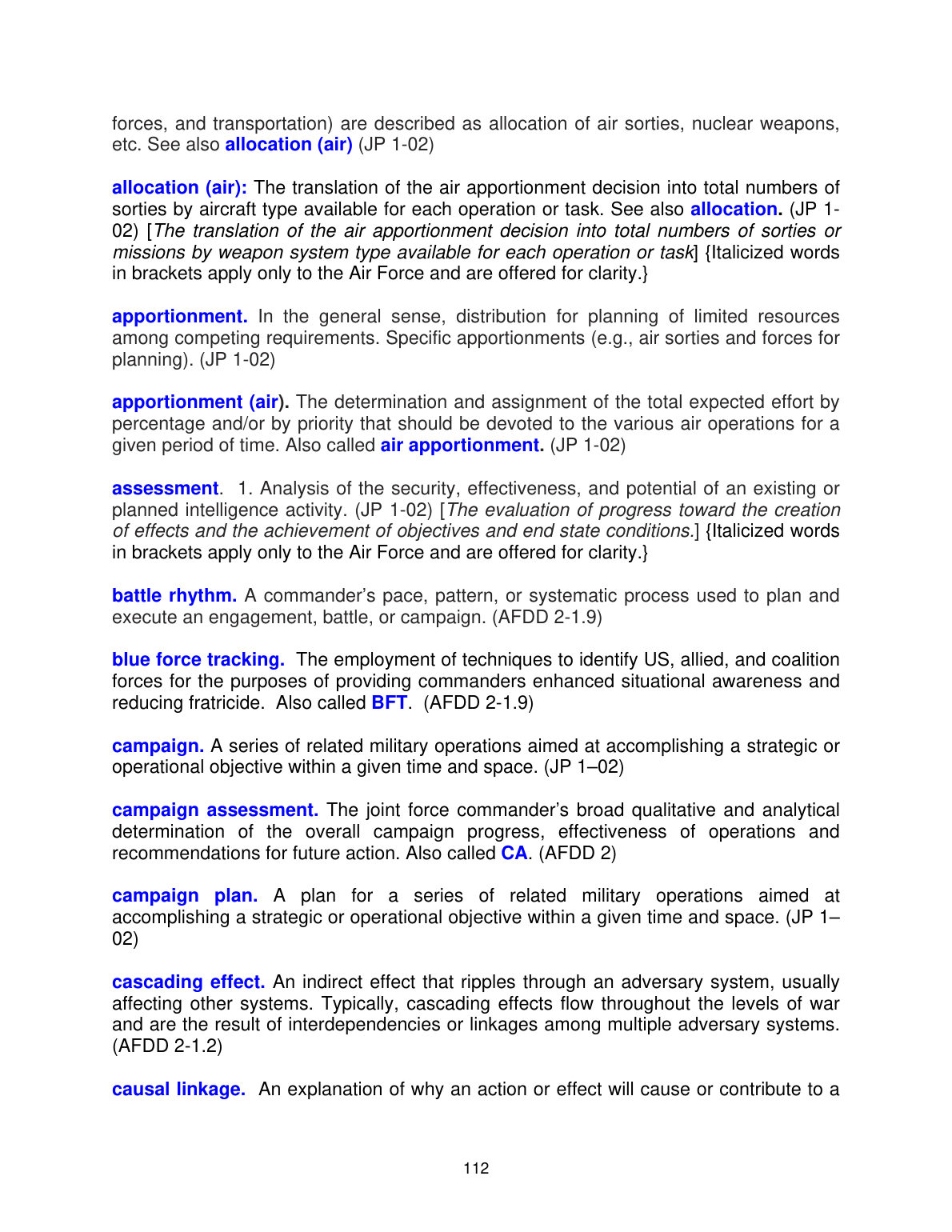
…In the general sense, distribution for planning of limited resources among competing requirements. Specific apportionments (e.g., air sorties and forces for planning). (JP 1-02) apportionment (air). The determination and assignment of the total expected…
Joint Targeting
Military manual · JP 3-60

JP 3-60, page 29

Joint Targeting

Joint Publication: Joint Targeting

…As the operation progresses, joint operation planning generally occurs in three distinct but overlapping timeframes: future plans, future operations, and current operations. The joint force battle rhythm and the JFC’s decision cycle are two factors…
Intelligence Analysis
Military manual · ATP 2-33.4

ATP 2-33.4, page 26

Intelligence Analysis

Army Techniques Publication: Intelligence Analysis

…Some fallacies of omission include oversimplification, composition, division, post hoc, false dilemma, hasty generalization, and special pleading. e@ Oversimplification is a generality that fails to adequately account for all the complex conditions bearing on a problem…
Intelligence Analysis
Military manual · ATP 2-33.4

ATP 2-33.4, page 117

Intelligence Analysis

Army Techniques Publication: Intelligence Analysis

…Using Morphological Analysis in combination with Multiple Scenarios Generation aids in reducing unforeseen potential and identifying extreme cases of interaction between an issue’s drivers. Generating multiple scenarios in this format gives the analyst the advantage…
Joint Targeting
Military manual · JP 3-60

JP 3-60, page 60

Joint Targeting

Joint Publication: Joint Targeting

…Attack recommendations are generally not made using BDA phase I information. However, in cases of a confirmed miss, a reattack may be authorized based on target priority and weapon availability. 5. Further, assessment takes place in…
Intelligence Analysis
Military manual · ATP 2-33.4

ATP 2-33.4, page 143

Intelligence Analysis

Army Techniques Publication: Intelligence Analysis

…ODIERNO General, United States Army Chief of Staff Official: GERALD B. O’KEEFE Administrative Assistant to the Secretary of the Army 1421314 DISTRIBUTION: Active Army, Army National Guard, and United States Army Reserve: Distributed in electronic…