Advanced search

About 49 results · showing 21–40 · page 2 of 3 · Edit filters

Targeting
Military manual · AFDD 2-1.9

AFDD 2-1.9, page 91

Targeting

Air Force Doctrine Document: Targeting

…This applies to intelligence personnel as well as operators, weather personnel, IO specialists, and any others who are involved with CAOC targeting. It also includes federated and reachback partners. A number of courses provide training on…
Joint Targeting
Military manual · JP 3-60

JP 3-60, page 49

Joint Targeting

Joint Publication: Joint Targeting

…Other factors include maintenance failure, defenses, and weather. Weaponeering personnel should factor this attrition analysis and PA data into their PD calculations. (b) Assemble Data on Friendly Force Status, Factoring in Operational Limitations and Apportionment Guidance…
Intelligence Analysis
Military manual · ATP 2-33.4

ATP 2-33.4, page 88

Intelligence Analysis

Army Techniques Publication: Intelligence Analysis

… Identify terrain and weather that supports enemy defensive operations.  Identify terrain and weather that supports friendly movement and maneuver.  Determine the impact of civil considerations and displaced civilians on friendly and enemy operations…
Intelligence Analysis
Military manual · ATP 2-33.4

ATP 2-33.4, page 53

Intelligence Analysis

Army Techniques Publication: Intelligence Analysis

…All-source intelligence analysts study and provide mission-focused knowledge of the terrain and weather, civil considerations, and threat characteristics for a specified area or region of a foreign country— including the attitudes of the populace…
Targeting
Military manual · AFDD 2-1.9

AFDD 2-1.9, page 65

Targeting

Air Force Doctrine Document: Targeting

55 › Responding to changes in weather. A target planner’s actions will be similar to when he responds to changes in friendly operations. Further, changes in weather may require changes to the platforms and/or weapons…
Targeting
Military manual · AFDD 2-1.9

AFDD 2-1.9, page 118

Targeting

Air Force Doctrine Document: Targeting

…CONOPS concept of operations CONPLAN CONUS contingency plan continental United States CPD combat plans division CWF combat weather flight DCGS distributed common ground/surface systems DGS distributed ground station DHS Department of Homeland Security DIA Defense…
Joint Targeting
Military manual · JP 3-60

JP 3-60, page 58

Joint Targeting

Joint Publication: Joint Targeting

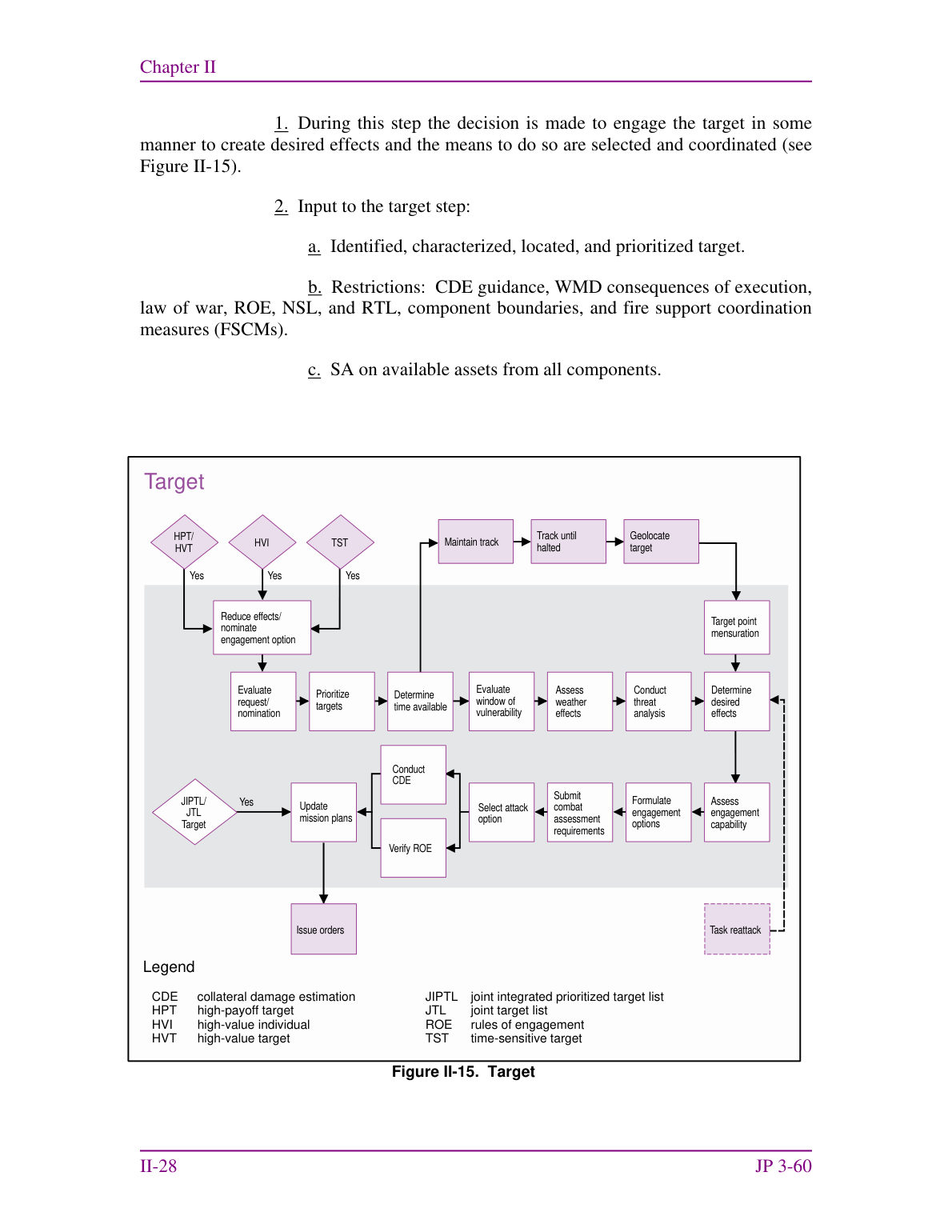
…TST Yes Yes Yes Yes Reduce effects/ nominate engagement option Target point mensuration Formulate engagement options Assess weather effects Determine desired effects Evaluate request/ nomination Submit combat assessment requirements Conduct CDE Conduct threat analysis Prioritize targets…
Targeting
Military manual · AFDD 2-1.9

AFDD 2-1.9, page 73

Targeting

Air Force Doctrine Document: Targeting

Weather effects are determined by the WST, leveraging reachback support from the operational weather unit for their region. Logistics inputs may come from many sources, including the COMAFFOR’s A-4 (Logistics) and the AMD. Lower…
Targeting
Military manual · AFDD 2-1.9

AFDD 2-1.9, page 49

Targeting

Air Force Doctrine Document: Targeting

…The danger of collateral damage varies with the type of target, terrain, weapons used, weather, and the proximity of civilians and their structures. According to LOAC, incidental damage to civilian objects must not be excessive in…
Intelligence Analysis
Military manual · ATP 2-33.4

ATP 2-33.4, page 90

Intelligence Analysis

Army Techniques Publication: Intelligence Analysis

…In DSCA, analysts are expected to provide an analysis of the physical environment, weather impacts, terrorist threats, and chemical, biological, radiological, or nuclear hazards. Instead of conducting IPB, analysts conduct a modified intelligence preparation of the…
Intelligence Analysis
Military manual · ATP 2-33.4

ATP 2-33.4, page 16

Intelligence Analysis

Army Techniques Publication: Intelligence Analysis

…As an element of the Army Mission Command System (MCS), the core functions of DCGS-A are tasking of intelligence sensors, processing of data, exploitation of data, and dissemination of intelligence information about the threat, weather
Targeting
Military manual · AFDD 2-1.9

AFDD 2-1.9, page 72

Targeting

Air Force Doctrine Document: Targeting

…At the tactical level, combat weather flights (CWF) are responsible for determining and integrating weather effects into the decision cycle. At the component level, weather personnel assigned to the CAOC assess and integrate weather effects into…
Offense and Defense
Military manual · ADP 3-90

ADP 3-90, page 12

Offense and Defense

Army Doctrine Publication: Offense and Defense

…A tactical problem occurs when the mission variables—mission, enemy, terrain and weather, troops and support available, time available, and civil considerations (known as METT-TC)—of the desired tactical situation differ from the current situation…
Offense and Defense
Military manual · ADP 3-90

ADP 3-90, page 42

Offense and Defense

Army Doctrine Publication: Offense and Defense

…Commanders deceive an enemy force as to the nature, timing, and objective of an attack by using bad weather, seemingly impassable terrain, and military deception to shape enemy perceptions. Airborne, air assault, and special operations forces…
Military Operations on Urbanized Terrain (MOUT)
Military manual · MCRP 12-10B.1

MCRP 12-10B.1, page 34

Military Operations on Urbanized Terrain (MOUT)

Marine Corps Reference Publication: Military Operations on Urbanized Terrain (MOUT)

…Marines follow the same planning process in MOUT as for other operational environments by evaluating the mission, enemy, terrain and weather, troops and support available, and time available (METT-T). Based on METT-T and application…
Military Operations on Urbanized Terrain (MOUT)
Military manual · MCRP 12-10B.1

MCRP 12-10B.1, page 35

Military Operations on Urbanized Terrain (MOUT)

Marine Corps Reference Publication: Military Operations on Urbanized Terrain (MOUT)

…Terrain and Weather (1) Terrain. Offensive operations should be tailored to the urban environment based on a detailed analysis of urbanized terrain (see Appendix I). Commanders and subordinate leaders use KOCOA (key terrain, observation and fields…
Military Operations on Urbanized Terrain (MOUT)
Military manual · MCRP 12-10B.1

MCRP 12-10B.1, page 357

Military Operations on Urbanized Terrain (MOUT)

Marine Corps Reference Publication: Military Operations on Urbanized Terrain (MOUT)

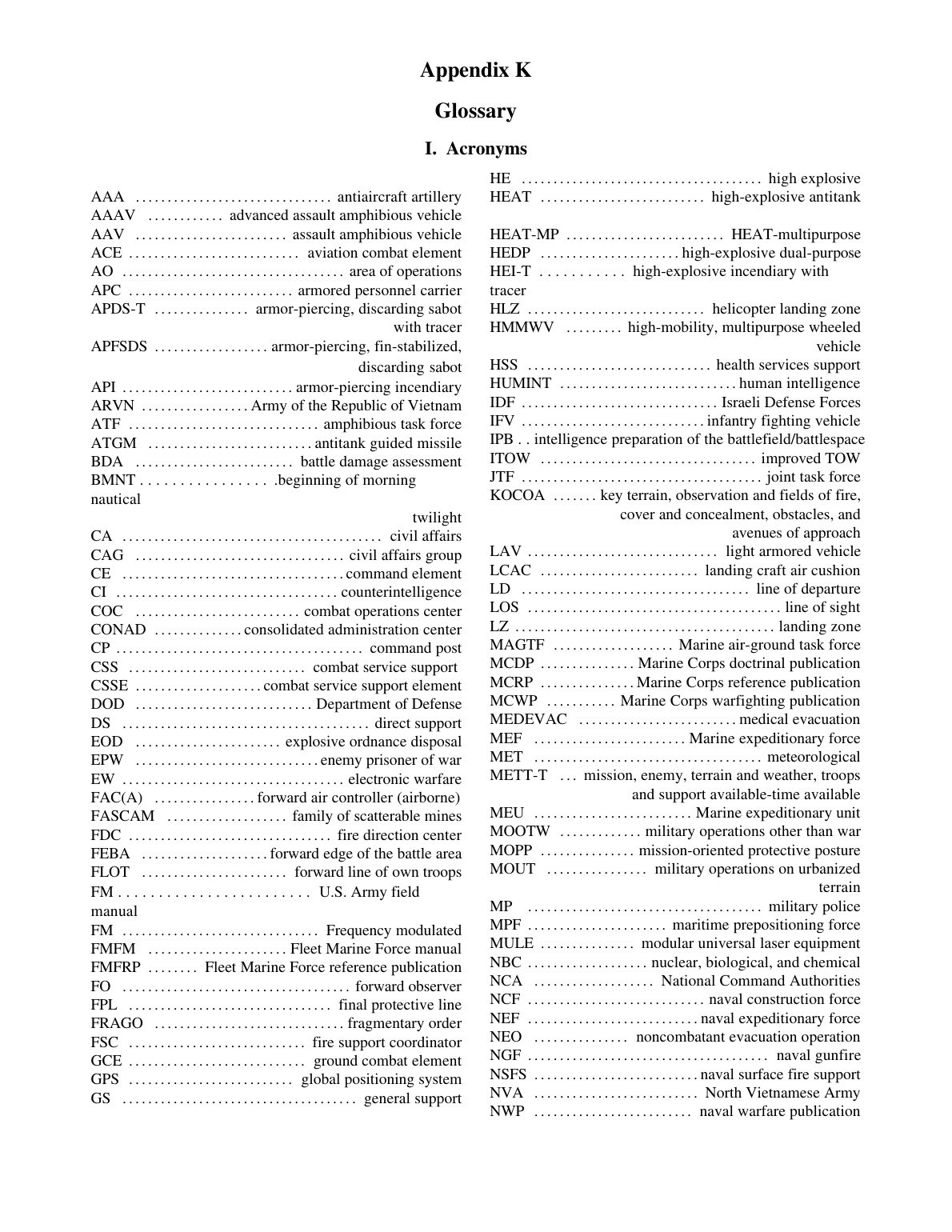
…mission, enemy, terrain and weather, troops and support available-time available MEU . . . . . . . . . . . . . . . . . . . . . . . . . Marine expeditionary unit MOOTW . . . . . . . . . . . . . military operations other than war MOPP . . . . . . . . . . . . . . . mission-oriented protective posture MOUT . . . . . . . . . . . . . . . . military operations on urbanized terrain MP . . . . . . . . . . . . . . . . . . . . . . . . . . . . . . . . . . . . . military police MPF…
Offense and Defense
Military manual · ADP 3-90

ADP 3-90, page 93

Offense and Defense

Army Doctrine Publication: Offense and Defense

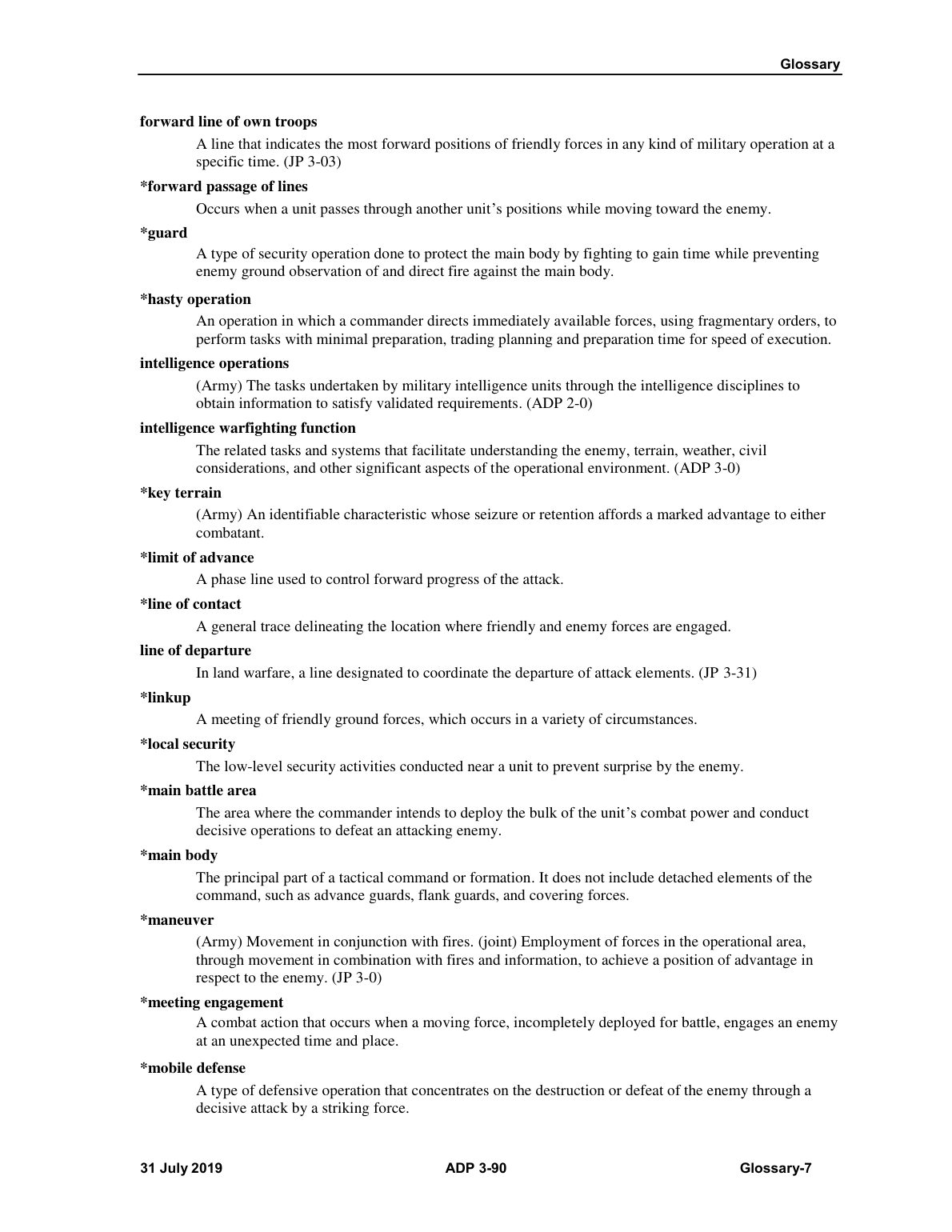
…ADP 2-0) intelligence warfighting function The related tasks and systems that facilitate understanding the enemy, terrain, weather, civil considerations, and other significant aspects of the operational environment. (ADP 3-0) *key terrain (Army) An identifiable…
Military Operations on Urbanized Terrain (MOUT)
Military manual · MCRP 12-10B.1

MCRP 12-10B.1, page 355

Military Operations on Urbanized Terrain (MOUT)

Marine Corps Reference Publication: Military Operations on Urbanized Terrain (MOUT)

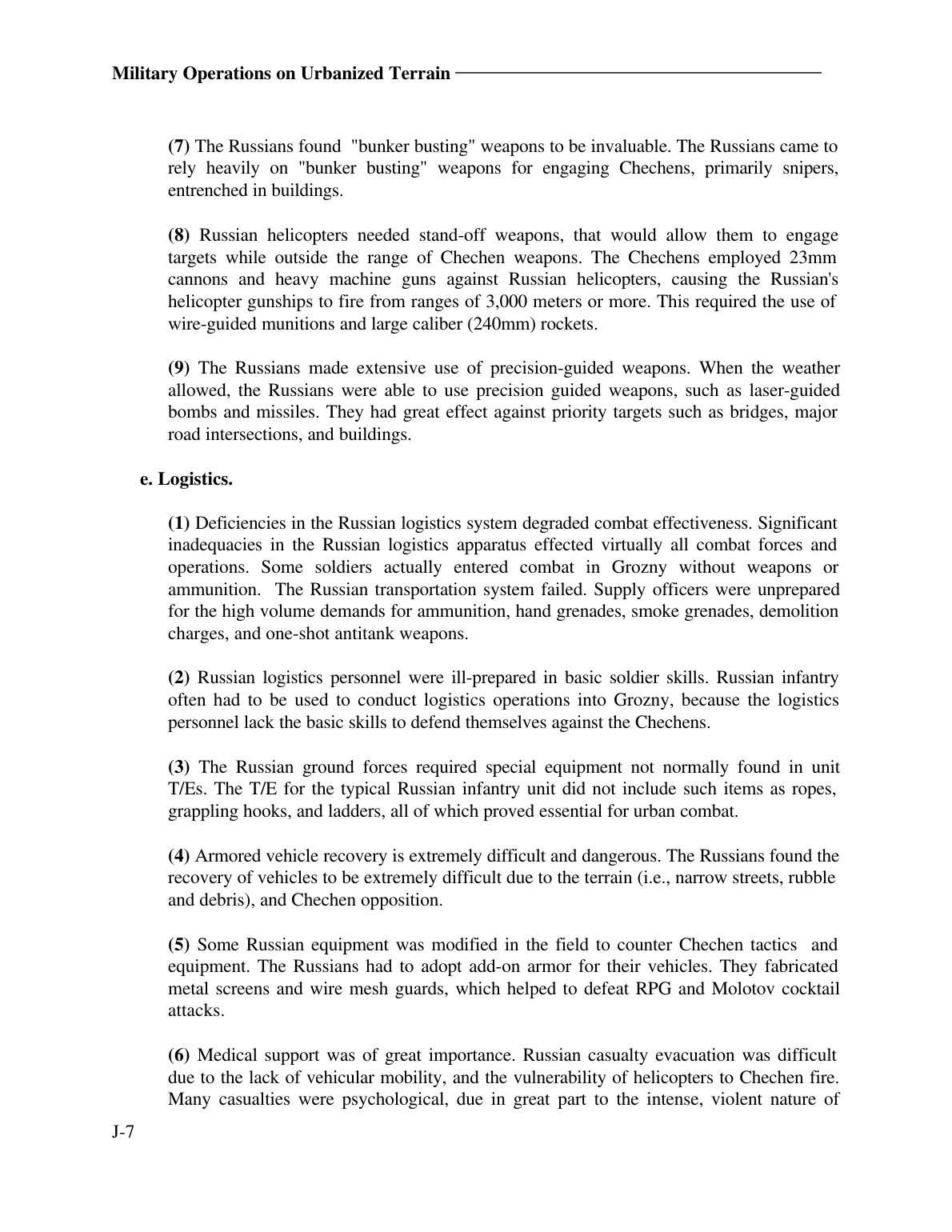
…When the weather allowed, the Russians were able to use precision guided weapons, such as laser-guided bombs and missiles. They had great effect against priority targets such as bridges, major road intersections, and buildings. e…
Military Operations on Urbanized Terrain (MOUT)
Military manual · MCRP 12-10B.1

MCRP 12-10B.1, page 329

Military Operations on Urbanized Terrain (MOUT)

Marine Corps Reference Publication: Military Operations on Urbanized Terrain (MOUT)

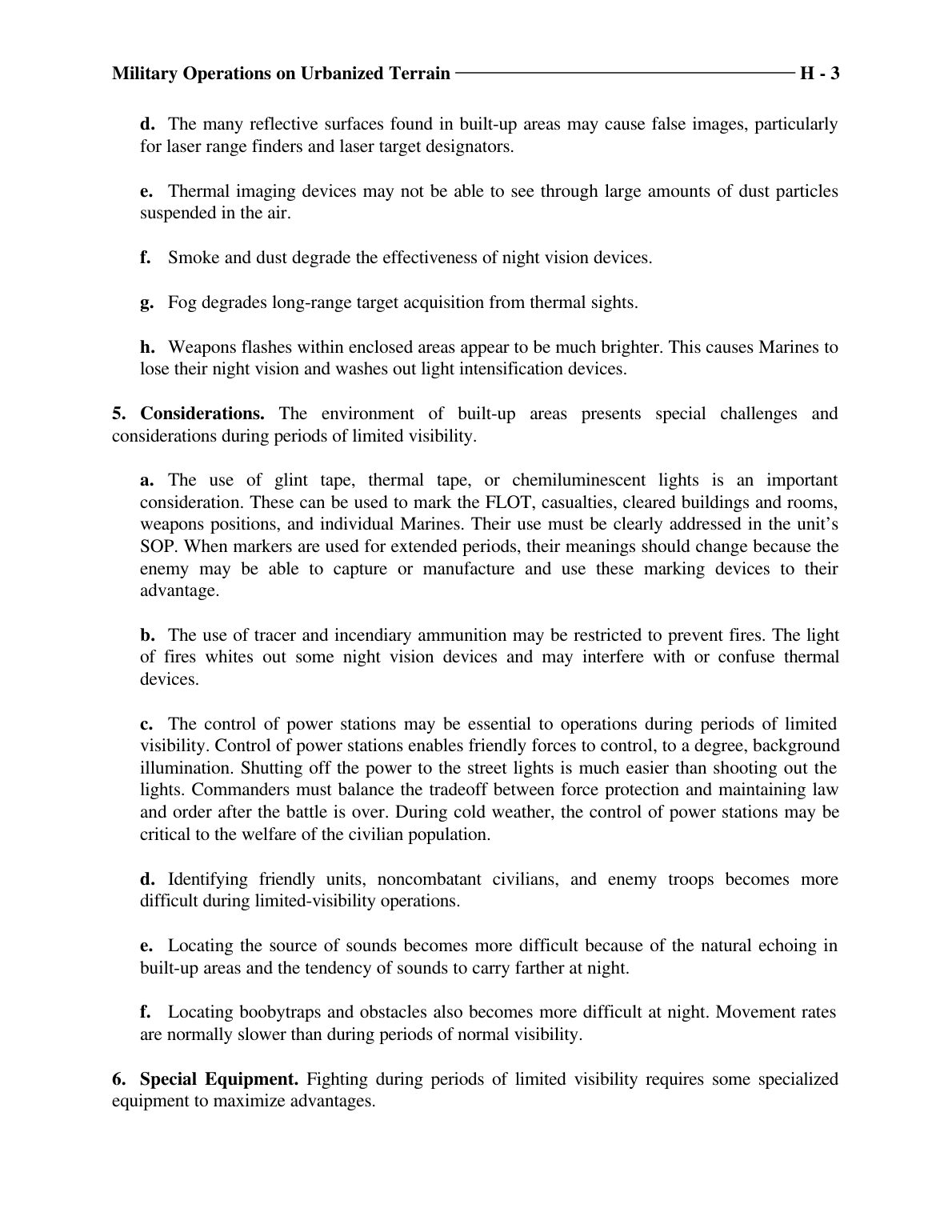
…During cold weather, the control of power stations may be critical to the welfare of the civilian population. d. Identifying friendly units, noncombatant civilians, and enemy troops becomes more difficult during limited-visibility operations. e. Locating…