Advanced search

carlton johnson ii

About 142 results · showing 121–140 · page 7 of 8 · Edit filters

Joint Targeting
Military manual · JP 3-60

JP 3-60, page 36

Joint Targeting

Joint Publication: Joint Targeting

Chapter II II-6 JP 3-60 capabilities. JIPOE helps target developers prioritize an adversary’s target systems based on how much each contributes to the adversary’s ability to wage war. (b) Establishing intelligence requirements…
Joint Operations
Military manual · JP 3-0

JP 3-0, page 50

Joint Operations

Joint Publication: Joint Operations

Chapter II II-10 JP 3-0 objectives. Assessment actions and measures help commanders adjust operations and resources as required, determine when to execute branches and sequels, and make other critical decisions to ensure current and…
Joint Targeting
Military manual · JP 3-60

JP 3-60, page 45

Joint Targeting

Joint Publication: Joint Targeting

The Joint Targeting Cycle II-15 (3) All estimates generated during this phase are situation-specific, reflecting the pairing of forces against targets under particular conditions of employment. As such, users of this information must use…
Joint Operations
Military manual · JP 3-0

JP 3-0, page 44

Joint Operations

Joint Publication: Joint Operations

Chapter II II-4 JP 3-0 understand the conditions for victory before seeking battle. Without operational art, campaigns and operations would be sets of disconnected events. Operational art governs the deployment of forces and the…
Joint Targeting
Military manual · JP 3-60

JP 3-60, page 48

Joint Targeting

Joint Publication: Joint Targeting

Chapter II II-18 JP 3-60 operational picture (COP) are critical elements during phase 6 of the joint targeting cycle where outcomes are analyzed and future actions are determined. (3) Targeteers work closely with planners…
Joint Targeting
Military manual · JP 3-60

JP 3-60, page 113

Joint Targeting

Joint Publication: Joint Targeting

…The command designated BDA cell is responsible for collating reports and making the final assessment. (b) BDA Phase II, Functional Damage/Change Assessment 1. Functional damage assessment is an estimate of the degradation or destruction of…
Joint Targeting
Military manual · JP 3-60

JP 3-60, page 43

Joint Targeting

Joint Publication: Joint Targeting

The Joint Targeting Cycle II-13 2. Restricted. A restricted target is a valid target that has specific restrictions placed on the actions authorized against it due to operational considerations. Actions that exceed specified restrictions are…
Joint Targeting
Military manual · JP 3-60

JP 3-60, page 114

Joint Targeting

Joint Publication: Joint Targeting

…These assessments may be conducted at the combatant command or national-level by fusing all phases I and II BDA reporting on targets within a target system. 2. BDA phase III produces a target system assessment…
Targeting
Military manual · AFDD 2-1.9

AFDD 2-1.9, page 23

Targeting

Air Force Doctrine Document: Targeting

13 At least as far back as World War II, some air planners were trying to implement the essential concepts of [an effects-based approach]. In the late 1930’s, particularly at the Air Corps Tactical…
Joint Operations
Military manual · JP 3-0

JP 3-0, page 48

Joint Operations

Joint Publication: Joint Operations

Chapter II II-8 JP 3-0 (3) Commander’s Planning Guidance. JFCs guide the joint force’s actions throughout planning and execution. However, the staff and component commanders typically expect the JFC to issue initial…
Joint Operations
Military manual · JP 3-0

JP 3-0, page 47

Joint Operations

Joint Publication: Joint Operations

The Art of Joint Command II-7 require the commander’s participation and decisions. These include the operational approach, mission statement, commander’s planning guidance, commander’s intent, commander’s critical information requirements (CCIRs), and CONOPS…
Joint Targeting
Military manual · JP 3-60

JP 3-60, page 32

Joint Targeting

Joint Publication: Joint Targeting

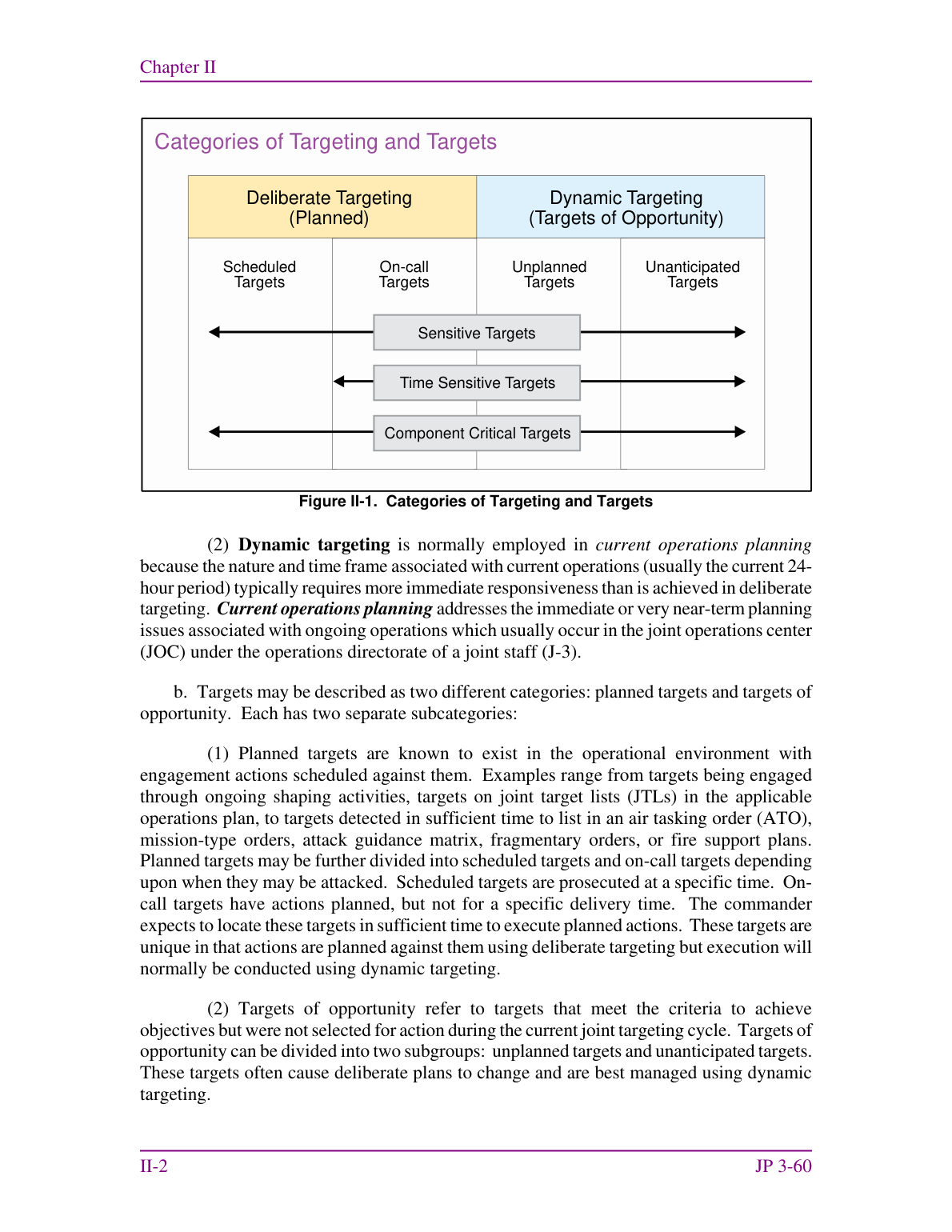
Chapter II II-2 JP 3-60 (2) Dynamic targeting is normally employed in current operations planning because the nature and time frame associated with current operations (usually the current 24- hour period) typically requires more…
Joint Targeting
Military manual · JP 3-60

JP 3-60, page 51

Joint Targeting

Joint Publication: Joint Targeting

The Joint Targeting Cycle II-21 The joint targeting process monitors these changes in order to allow commanders to decisively use joint force capabilities to seize and maintain the initiative. These dynamic changes require particular attention…
Joint Targeting
Military manual · JP 3-60

JP 3-60, page 33

Joint Targeting

Joint Publication: Joint Targeting

The Joint Targeting Cycle II-3 (a) Unplanned targets are known targets and are included on a target list, but not selected for engagement because the target was not nominated, was nominated but did not make…
Joint Targeting
Military manual · JP 3-60

JP 3-60, page 35

Joint Targeting

Joint Publication: Joint Targeting

The Joint Targeting Cycle II-5 desired end state. The ability to generate the type and extent of effects necessary to achieve the commander’s objectives distinguishes effective targeting. For more information on end state and…
Joint Operations
Military manual · JP 3-0

JP 3-0, page 46

Joint Operations

Joint Publication: Joint Operations

Chapter II II-6 JP 3-0 transforms national strategic objectives into activities by development of operational products, which include planning for the mobilization, deployment, employment, sustainment, redeployment, and demobilization of joint forces. It ties the…
Joint Targeting
Military manual · JP 3-60

JP 3-60, page 44

Joint Targeting

Joint Publication: Joint Targeting

Chapter II II-14 JP 3-60 (b) Capabilities Assignment. Once a target’s vulnerabilities are known, appropriate target engagement capabilities are assigned. Target engagement capabilities may be either lethal or nonlethal weapons or capabilities. All…
Joint Targeting
Military manual · JP 3-60

JP 3-60, page 66

Joint Targeting

Joint Publication: Joint Targeting

Chapter II II-36 JP 3-60 are usually immediate and easily recognizable. (For example, an enemy C2 center is destroyed by friendly artillery or a terrorist network courier is captured by a direct action mission…
Joint Targeting
Military manual · JP 3-60

JP 3-60, page 40

Joint Targeting

Joint Publication: Joint Targeting

Chapter II II-10 JP 3-60 adversary to organize substitute consumption, alternate production, or procurement before the system is functionally degraded. c. Recuperation is a measurement of the time and cost required for a target…
Joint Targeting
Military manual · JP 3-60

JP 3-60, page 34

Joint Targeting

Joint Publication: Joint Targeting

Chapter II II-4 JP 3-60 c. Phase 1—The End State and Commander’s Objectives (1) Understanding the military end state and the commander’s intent, centers of gravity (COGs), objectives, desired effects, and…