Advanced search

damage

About 198 results · showing 41–60 · page 3 of 10 · Last 14 days (since 2026-10-30) · Clear date limit · Edit filters

Joint Operations
Military manual · JP 3-0

JP 3-0, page 175

Joint Operations

Joint Publication: Joint Operations

…Restraint (1) The purpose of restraint is to limit collateral damage and prevent the unnecessary use of force. (2) A single act could cause significant military and political consequences; therefore, judicious use of force is necessary…
Targeting
Military manual · AFDD 2-1.9

AFDD 2-1.9, page 72

Targeting

Air Force Doctrine Document: Targeting

…This information is used to determine if collection assets other than those inherent in the weapon(s), aircraft, or aircrew are required to establish the level of physical and functional damage inflicted on selected targets. EDA…
Targeting
Military manual · AFDD 2-1.9

AFDD 2-1.9, page 26

Targeting

Air Force Doctrine Document: Targeting

…combatant commanders, the Secretary of Defense, and the President. › There may be greater emphasis upon minimizing collateral damage (CD) and CD risk calculations may be scrutinized by higher-level leaders than in major combat operations. This…
Joint Operations
Military manual · JP 3-0

JP 3-0, page 133

Joint Operations

Joint Publication: Joint Operations

…Strikes and Raids (1) Strikes are attacks conducted to damage or destroy an objective or a capability. Strikes may be used to punish offending nations or groups, uphold international law, or prevent those nations or groups…
Targeting
Military manual · AFDD 2-1.9

AFDD 2-1.9, page 18

Targeting

Air Force Doctrine Document: Targeting

…Examples might include leadership targets that must be handled sensitively due to potential political repercussions, targets located in areas with a high risk of collateral civilian damage, or weapons of mass destruction (WMD) facilities, where improper…
Joint Targeting
Military manual · JP 3-60

JP 3-60, page 45

Joint Targeting

Joint Publication: Joint Targeting

…Inputs to these calculations include target characteristics (e.g., size, shape, and hardness), desired damage criteria or probability of damage (PD) calculations, and delivery parameters (e.g., altitudes, speeds, dive angles). Model outputs include the predicted…
Joint Targeting
Military manual · JP 3-60

JP 3-60, page 64

Joint Targeting

Joint Publication: Joint Targeting

…Step 4 of phase 3 is “effects estimate.” As stated earlier, during this step the desired effect of engaging the target at the target element level is defined and the undesired effects (e.g., collateral damage…
Targeting
Military manual · AFDD 2-1.9

AFDD 2-1.9, page 123

Targeting

Air Force Doctrine Document: Targeting

…Unintentional or incidental injury or damage to persons or objects that would not be lawful military targets in the circumstances ruling at the time. Such damage is not unlawful so long as it is not excessive…
Targeting
Military manual · AFDD 2-1.9

AFDD 2-1.9, page 129

Targeting

Air Force Doctrine Document: Targeting

…The process of determining the quantity of a specific type of lethal or nonlethal weapons required to achieve a specific level of damage to a given target,
Joint Targeting
Military manual · JP 3-60

JP 3-60, page 15

Joint Targeting

Joint Publication: Joint Targeting

…Items to be considered in the risk assessment include risk to civilians, friendly forces, and noncombatants; possible collateral damage; and the disruption incurred by diverting assets from their deliberately planned missions. The Relationship Between Targeting and…
Joint Targeting
Military manual · JP 3-60

JP 3-60, page 40

Joint Targeting

Joint Publication: Joint Targeting

…A target’s vulnerability refers to the physical susceptibility to damage, disruption, intrusion, interference, or other desired effect. Vulnerability affects the size and types of action required to damage, disrupt, or otherwise affect a target, in…
Joint Operations
Military manual · JP 3-0

JP 3-0, page 51

Joint Operations

Joint Publication: Joint Operations

…battle damage assessment, munitions effectiveness assessment, and reattack recommendations or future targeting. However, combat assessment methodology also can be applied by joint force functional and Service components to other tactical tasks not associated with joint fires…
Targeting
Military manual · AFDP 3-60

AFDP 3-60, page 9

Targeting

Air Force Doctrine Publication: Targeting

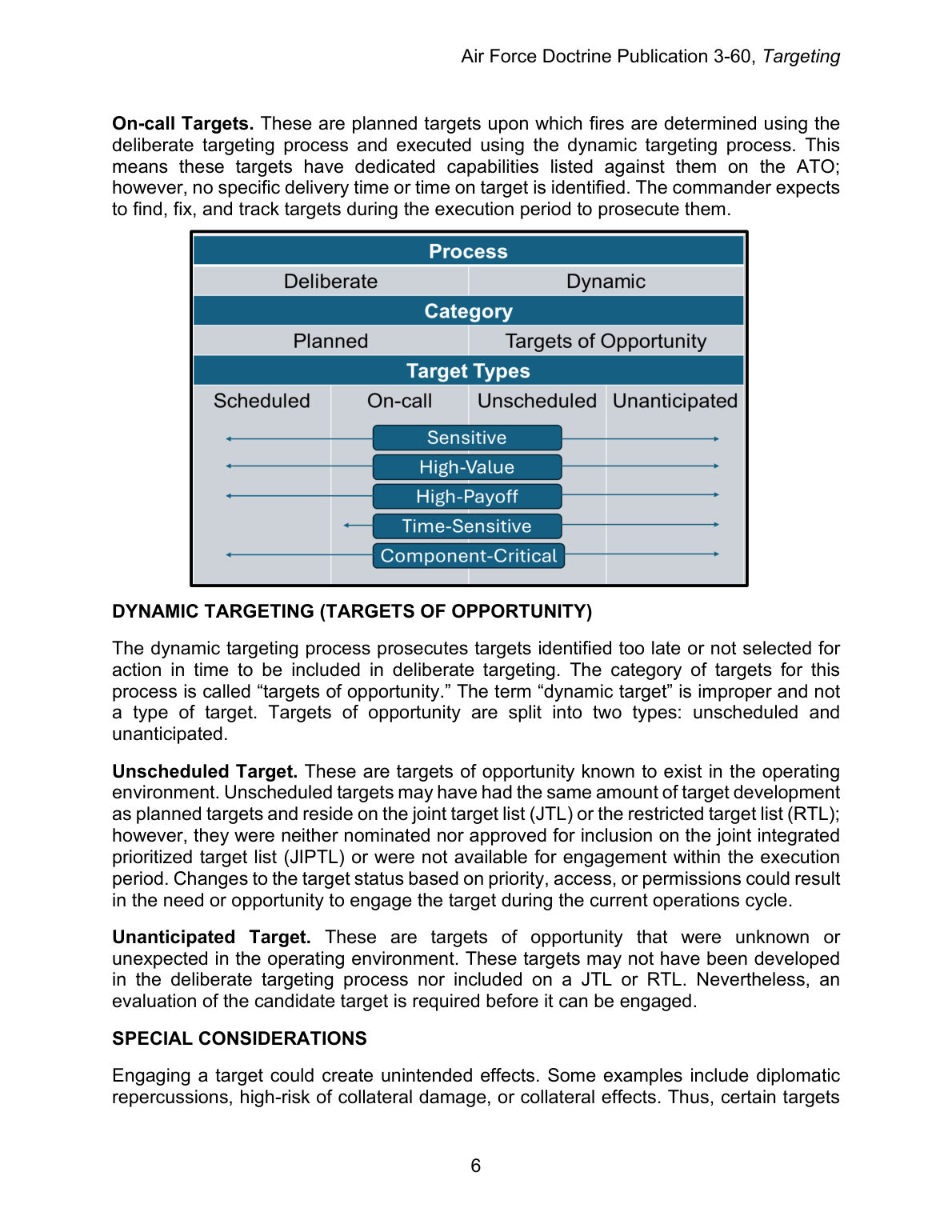
…Some examples include diplomatic repercussions, high-risk of collateral damage, or collateral effects. Thus, certain targets
Joint Targeting
Military manual · JP 3-60

JP 3-60, page 67

Joint Targeting

Joint Publication: Joint Targeting

…Collateral Damage Prevention. The United States of America places a high value on preserving civilian and noncombatant lives and property and seeks to accomplish its mission through the discriminate application of force with minimal collateral damage…
Targeting
Military manual · AFDP 3-60

AFDP 3-60, page 17

Targeting

Air Force Doctrine Publication: Targeting

…Specific data provided to mission planners should be checked for integrity, including verification of target coordinates, elevations, weapon azimuths, and impact dive angles, fuzing instructions, collateral damage considerations, and target area graphics, when direct electronic transfer…
Targeting
Military manual · AFDD 2-1.9

AFDD 2-1.9, page 105

Targeting

Air Force Doctrine Document: Targeting

…ROLE OF THE JUDGE ADVOCATE So what does the JA have to do with targeting? The JA assists the planners and operators with reviewing targets for compliance with applicable LOAC/ROE restrictions (including collateral damage and…
Targeting
Military manual · AFDD 2-1.9

AFDD 2-1.9, page 99

Targeting

Air Force Doctrine Document: Targeting

…Does the military advantage to be gained from striking a target outweigh the anticipated incidental civilian loss of life and property if this target is struck? This requires the anticipated loss of civilian life and damage…
Targeting
Military manual · AFDD 2-1.9

AFDD 2-1.9, page 45

Targeting

Air Force Doctrine Document: Targeting

…Many offices and agencies must be coordinated with to prevent fratricide, collateral damage, or propaganda leverage for the enemy. Some examples of where coordination and integration are required: › SOF. The joint forces special operations component commander…
Joint Targeting
Military manual · JP 3-60

JP 3-60, page 114

Joint Targeting

Joint Publication: Joint Targeting

Appendix D D-6 JP 3-60 purpose does it serve? Without these pre-attack assessments, wartime functional damage assessments may be inadequately stated. Ideally, BDA will be performed by, or with, the input of the…
Joint Targeting
Military manual · JP 3-60

JP 3-60, page 62

Joint Targeting

Joint Publication: Joint Targeting

…The JFC should carefully balance the risk between the TST threat and the potential for friendly fire and collateral damage. (3) Identifying specific communication requirements between component C2 elements of the joint force to conduct rapid…

s2underground.com's top guys (most active users last 30 days):

Last updated